
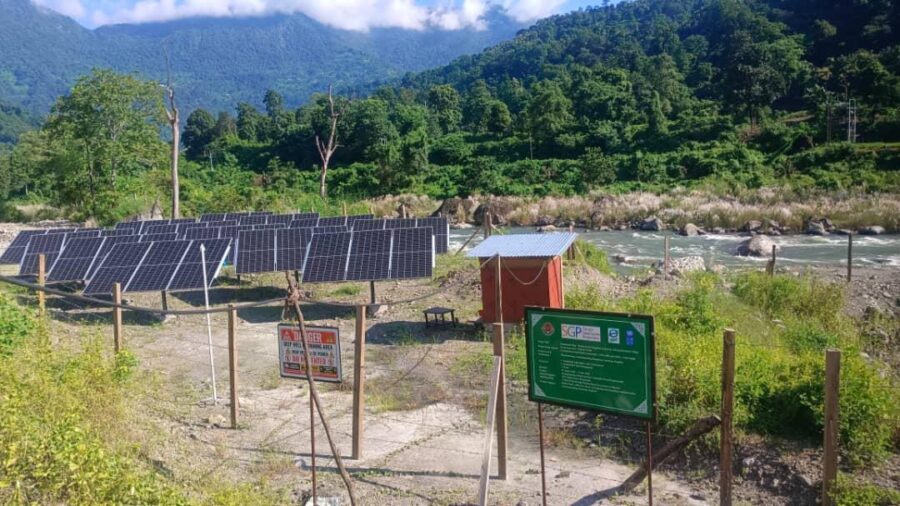
 For years, farmers in upper Tshangchutham in Samdrup Jongkhar watched a river flow below their village. However, they could never easily get its water to their fields. A solar-powered pump has now come to their rescue. Farmers hope the new system will help them plant paddy on time and also grow vegetables in winter.
In upper Tshangchutham of Phuentshothang Gewog, farmers have long depended on rainwater for farming, even with a river flowing below their fields. Today, a new system, using solar power to pump river water uphill, is helping feed water into the fields.
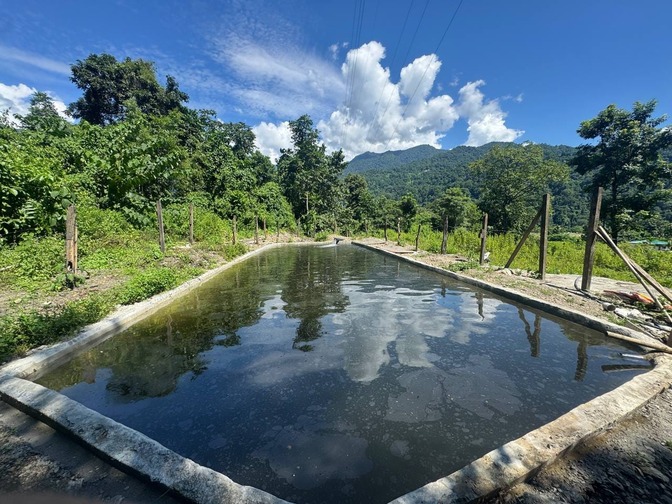
“We have the sump capacity of 1,000 cubic meters of water storage and solar capacity of 22-kilowatt and water will be lifted to a height of 45 meters and a length of 442meters,” said Hari Suberi, Community Coordinator, Upper Tsangchutham, Phuntshothang Gewog, SJ.
The water is stored in a reservoir above the village. It helps irrigate around 120 acres of farmland belonging to some 40 households.
“Tshangchutham is located on a hill, with the river running below. Bringing water up to the fields was difficult. This system offers the community a practical solution,” said Yam Bahadur Adhikari, Phuentshothang Tshogpa, Phuentshothang Gewog, SJ.
“We did not have enough water for farming before. This is the first system of its kind in our community, and we hope it will make a difference,” said Kharka Bahadur Tiwari, a farmer at Upper Tsangchutham, Phuentshothang Gewog, SJ.
“When water was scarce, we could not plant paddy on time. We hope this system will give us a more reliable supply. We are planning to grow vegetables in winter,” said Tulsi Ram Regmi, another farmer at Upper Tsangchutham, Phuentshothang Gewog, SJ.
The project cost more than Nu 4 M, received through the UNDP-GEF Small Grants Programme. The community, in collaboration with the local government authorities, executed the work. The State Mining Corporation Limited also provided machinery for excavation as part of its Corporate Social Responsibility.
The pump has given farmers another source of irrigation water when rain is insufficient. Its longer-term value will depend on how reliably it operates, how the water is shared, and who maintains the system. But for now, farmers are looking towards the next planting season with more options than they had before.
Kinley Wangchuk, Samdrup Jongkhar
Edited by Sonam Wangdi