
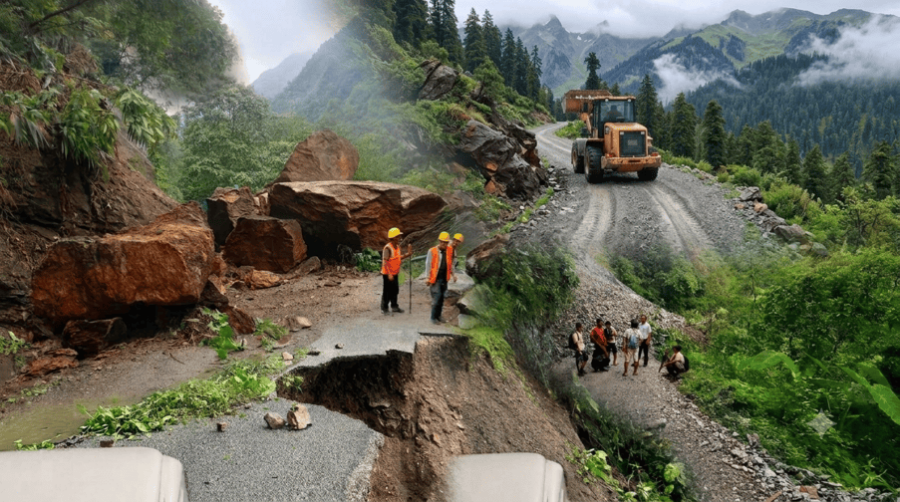
 Bhutan’s roads are facing a changing weather problem. Five years of data from the Infrastructure and Transport Ministry show that monsoon road closures are lasting far longer than before, even as winter snow blockages have almost disappeared. The Infrastructure and Transport Minister said landslides, flash floods, and debris flows are now keeping roads shut for days at a time, while the budget for repairs is being outpaced by the damage.
The numbers tell a story of a problem that is changing shape. According to the ministry, roads reopened within half a day per incident, on average, in the 2020-21 fiscal year. By the next period, the average closure stretched to around five days. It took three days once, but that is comparatively longer than it was before.
The count of blockages, however, has moved the other way. The ministry recorded 494 road blockages in 2020-21. Incidents peaked at over 1,400 in 2022-23 before declining to just over 300 in 2024-25. While fewer roads are being blocked, each blockage is keeping communities cut off for longer.
The ministry identified the Phuentsholing-Thimphu Highway, the main trade artery linking the capital to the Indian border, as the country’s most vulnerable national highway, with repeated and prolonged closures affecting national connectivity. The East-West Highway also continues to experience frequent disruptions during the monsoon.
What is blocking the road has also changed. Landslides have become the dominant cause of road blockages over the five-year period. They accounted for 25 per cent of all blockages in 2020-21, increasing to 68 per cent in 2024-25.
Increasing rainfall intensity and changing monsoon patterns are contributing to more rainfall-triggered slope failures. However, the ministry acknowledged that attributing increased incidents to climate change based on a single season is not scientifically appropriate and requires long-term observations and trend analysis.
“It rained so heavily last October. Much of our infrastructure was damaged, and we lost around Nu 1.3bn because of this rainfall. Primarily, it is the heavy, unprecedented rainfall that is the main cause of the road blockages: landslides,” said Chandra Bdr Gurung, Infrastructure and Transport Minister.
At the other end of the calendar, the picture is reversing. Road disruptions in winter have declined sharply. Snowfall-related road closures dropped by 94 per cent over the past five years, from 79 incidents in 2021-22 to just five incidents in 2024-25.
The decline in snowfall has reduced the need for de-icing operations, which are typically completed within three to four hours. As per the ministry, resources previously tied up in winter snow management could increasingly be redirected towards strengthening monsoon resilience.
But the arithmetic of that resilience is stark. The ministry currently allocates Nu 350 M annually for monsoon road restoration. Yet, damages in the current fiscal year have already crossed Nu 1.18bn. Minister Chandra Bahadur Gurung said that although the Cabinet approved an additional Nu 272 M in emergency funding, the allocation remains insufficient to meet the full cost of repairs.
“Currently, when we build a road, we are only building the pavement of the road. We are not incorporating climate change mitigation. If we have to add the cost of all these mitigation measures, then it will cost a lot,” said Chandra Bdr Gurung, Infrastructure and Transport Minister.
The strain is not only financial. The ministry highlighted manpower shortages, saying engineers in several regional offices are each responsible for maintaining more than 85 kilometres of roads, while also overseeing construction projects and emergency response during the monsoon.
Five years of the ministry’s data point to a shift: the challenge on Bhutan’s roads is no longer clearing winter snow, but paying for roads that can withstand the rain. And for the commuters, the question is not whether the rains will come, it is whether the roads will be ready when they do.
Sangay Chozom
Edited by Sonam Wangdi