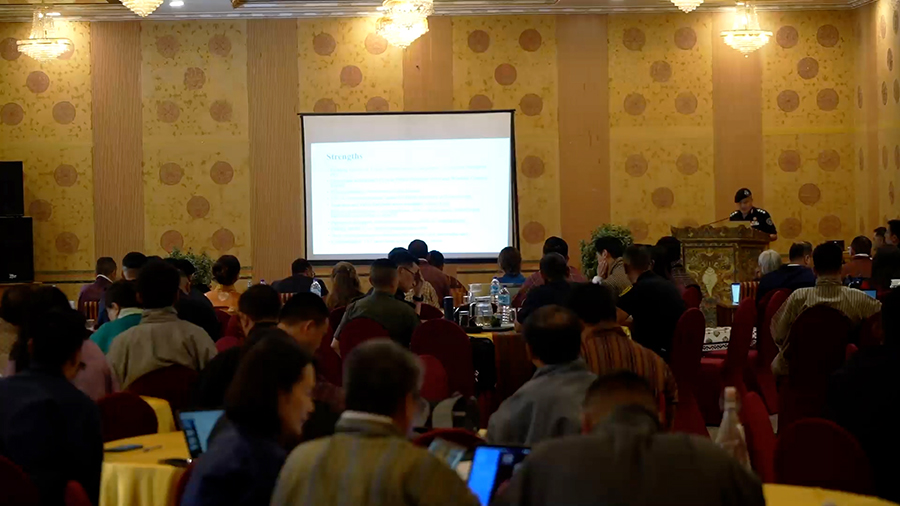
 Bhutan’s full-scale earthquake simulation exercise, conducted in Thimphu earlier this week, revealed critical gaps in coordination, communication, and emergency preparedness despite an overall successful response. The findings were presented during the After-Action Review following the multi-agency earthquake simulation conducted earlier this week.
At the field level, responders reported delays in earthquake activation, communication gaps, and weak coordination among emergency teams. Unclear reporting lines, limited manpower, equipment shortages, and delays in some services also affected operations.
At the National Referral Hospital, the drill successfully tested evacuation and patient management systems but exposed key vulnerabilities. These included limited capacity to assess building safety after an earthquake, inadequate ambulance resources, unreliable backup communication systems, and shortages of personnel for prolonged emergency response.
Meanwhile, the International Assistance Desk highlighted the challenge of quickly activating coordination mechanisms and engaging international partners during the critical early hours of a disaster.
Around 35 international experts and observers were involved in the design and execution of the exercise.
“Bhutan is sitting in this whole seismic area, and we need to be ready and agile. I think this exercise led to that stage where now we have to look at what lessons were learned. There was several feedback that have to be looked at, and we need to draw out short-term, medium-term and long-term preparedness plans that can feed into the contingency plan,” said Gaurav Ray, Resident Coordinator, UN Resident Coordinator’s Office.
“Bhutan has a lot of trained personnel for search and rescue, medical response or communications. But the most critical observation made was that the equipment or tools used by the search and rescue or even medical teams. So, the number of tools and equipment available to the teams needs to be improved,” said Surya N. Shrestha, Expert, Earthquake Simulation Exercise.
The review also provided recommendations to better activate coordination mechanisms, emergency contact management, and the need for faster engagement with international partners.
Stakeholders also recommended stronger pre-disaster coordination, updated emergency contact databases, training for emergency responders and frequent simulation exercises.
“We gathered here to individually share the lessons that we have learned. For example, what went well, what didn’t go well, and what are the recommendations to improve the Thimphu Contingency Plan so that we can integrate the lessons learned from the table-top simulation exercise,” said Yang Dorji, Chief Programme Officer, Department of Local Governance and Disaster Management.
According to the Department of Local Governance (DLGDM), the Coalition for Disaster Resilient Infrastructure (CDRI), an international agency based in India, and the National Society for Earthquake Technology, a non-governmental organisation of Nepal, would compile a comprehensive report of the simulation exercise.
After refining the Thimphu Earthquake Contingency Plan, the DLGDM plans to submit the document to the Prime Minister’s Office for replication in the remaining districts.
Kelzang Chhophyel & Karma Wangdi
Edited by Phub Gyem