
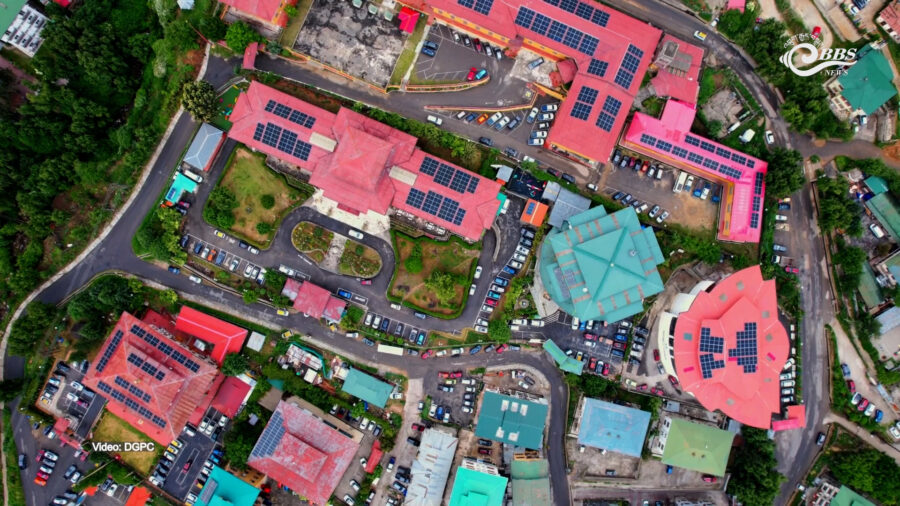
 Nearly 200 public facilities in three districts across the country have been equipped with solar power. The initiative is part of the Druk Green Power Corporation, DGPC’s project to distribute solar for public infrastructure. It aims to increase power generation and reduce reliance on hydropower.
Solar panels have been installed across 187 public infrastructure facilities in Thimphu, Basochhu Hydropower Project, and Chhukha Hydropower Project, investing nearly Nu 455 M.
Of this, 126 are located in Thimphu, 45 in Chhukha, and 16 in Basochhu.
The first phase has an installed capacity to produce a maximum power of 7.83 megawatt, expected to generate about 10.43 gigawatt-hours of electricity. This will be enough to power approximately over 2,500 average Bhutanese homes and generate revenue of around Nu 58 M annually.
The DGPC has proposed to sell the power generated from this project to the Bhutan Power Corporation at Nu5.56 ngultrum per kilowatt-hour.
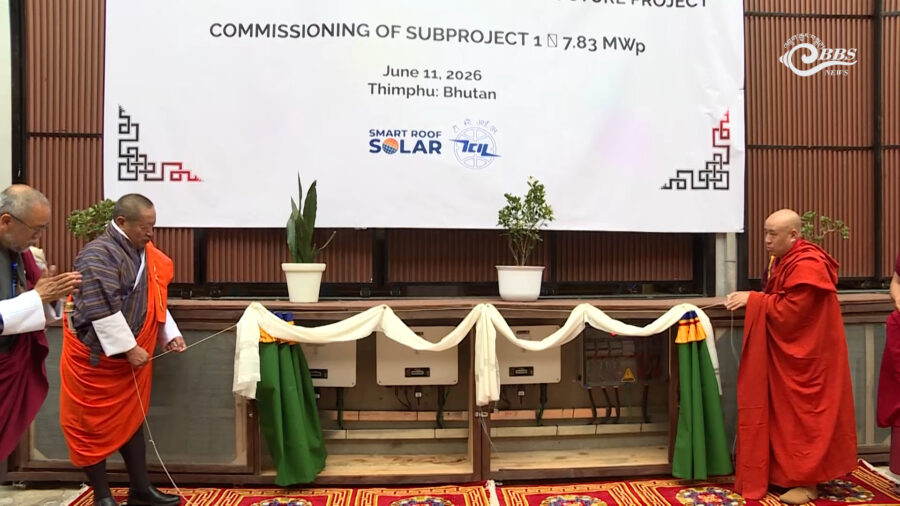 The project is part of a USD 34 million US dollar four-phased programme supported by the Asian Development Bank.
Once all the four phases complete by 2028, the project aims to install solar panels enough to produce a maximum of 35.5 megawatt of solar energy on public infrastructure nationwide.
The entire project is expected to generate 49 gigawatt-hours of clean electricity annually, which could roughly power around 12,000 to 16,000 Bhutanese households.
Beyond power generation, the project also aims to build a skilled local workforce in the solar sector.
As part of its capacity development programme, 16 trainees pursuing a diploma in solar technology at Jigme Wangchuck Power Training Institute in Sarpang, completed a month-long on-the-job training.
The initiative is aligned with the National Energy Policy 2025 and the National Solar Energy Roadmap 2025, which targets to generate 5,000 megawatts of solar energy by 2040.
Deki Lhazom