
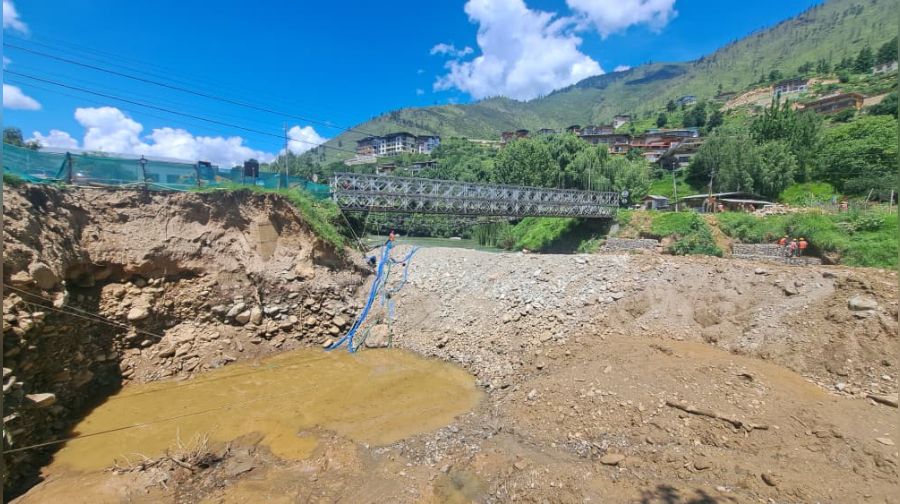
 After years of complaints about a narrow Bailey bridge and its deteriorating condition, construction of a new permanent bridge has finally begun at Debsi in Thimphu. The new bridge is expected to improve connectivity and road safety for commuters who have long struggled with the old infrastructure. The new bridge will be a 40-metre-long, two-lane structure with pedestrian walkways.
The old Bailey bridge connecting Debsi to Babesa has served commuters for more than two decades.
But the ageing structure can no longer keep up with the growing population and increasing traffic.
From just about five to six households around 15 years ago, Debsi now has more than two hundred buildings and around 3000 residents.
For years, people raised concerns about the narrow single lane, lack of a pedestrian walkway, and safety risks for both motorists and pedestrians.
Now, those long-standing concerns are being addressed. Construction of a new two-lane reinforced concrete bridge is underway.
Machinery and construction workers are mobilised at the site, marking the start of a project that residents have been waiting for years.
“The old bridge is very inconvenient. However, a new one is now being built, and it has been about one and a half months since the work started. Foundation work is currently underway, and a protection wall is being constructed due to landslides. The remaining work will follow after that. We hope the bridge will be completed within a year to a year and a half,” said Jambay, a resident.
“When heavy vehicles pass over the bridge, it vibrates. Due to the heavy load, there is a risk that the bridge could collapse. The new bridge is planned as a two-lane bridge, so it will have a greater load-carrying capacity. Moreover, it will save us time by ensuring smoother traffic flow,” said Tshering Dorji, a shopkeeper in Debsi.
“The current bridge is a one-way bridge. When vehicles come from one side, we have to wait at the other end, and vice versa. It is not very stable either. Some of the welded metal plates on the bridge have also come loose. Since the new bridge will be a two-lane bridge with a pedestrian footpath, it will be much more convenient,” said Kezang Phuntsho, also a resident.
According to the Ministry of Infrastructure and Transport, the bridge is being constructed at a cost of more than Nu 73 M.
The contract was awarded to a private construction company at the end of March this year to be completed within two years.
The Project Engineer of the bridge construction company said that the two-lane bridge is designed to accommodate increasing traffic and, with footpaths, improve pedestrian safety.
Although the work is on schedule, the engineer said seepage from the diverted river into the foundation of the new bridge is causing inconvenience. Despite deploying eight water pumps to drain the area, water continues to affect foundation work.
Currently, works to raise a protection wall are in progress to protect the old bridge from the diverted river, following which footing reinforcement of the new bridge would follow.
For residents of Debsi, the construction marks more than just another infrastructure project. It represents the beginning of a long-awaited solution to years of safety concerns and daily inconvenience.
Kelzang Chhophyel
Edited by Phub Gyem