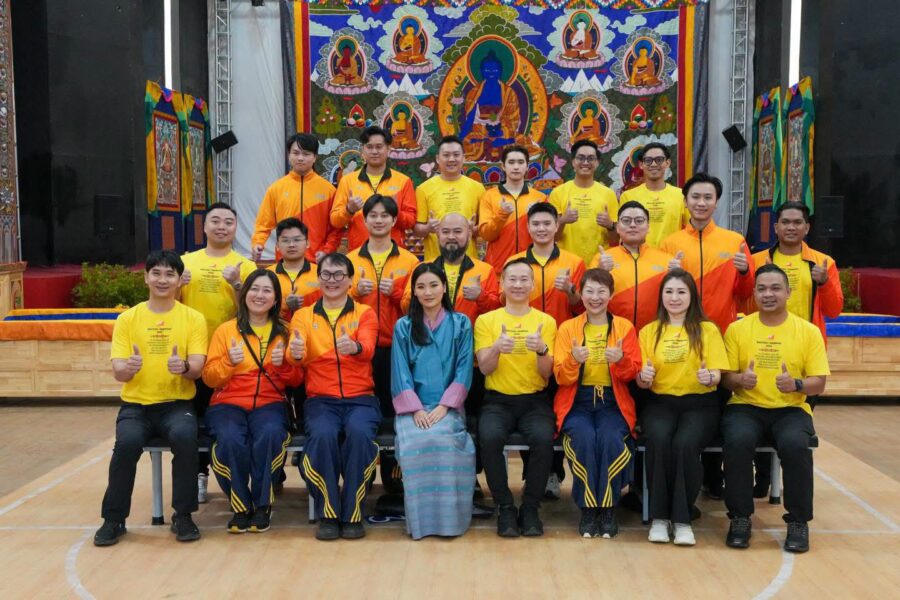
 A two-day Tit Tar therapy session is underway in Thimphu in honour of Her Majesty The Gyaltsuen’s birth anniversary on 4th June. Her Majesty graced the inaugural ceremony today. The traditional Tit-Tar Therapy team has returned to Bhutan for a second round of services.
Leading the sessions is Master Chris Leong from Malaysia, a globally recognised Tit Tar practitioner, joined by Master Erik Leong and a team of therapists. Master Leong and his team first held therapy sessions in Thimphu last November.
Tit Tar is a traditional practice focusing on realigning joints and bones while easing tension in muscles and tendons. The non-invasive technique is believed to relieve pain, improve flexibility, and restore the body’s natural harmony.
According to SELWA, the initiative aims to make Tit Tar therapy especially available to children living with disabilities and elders with chronic joint pains.
“I feel a little lighter. I have lived with this pain following an accident many years ago,” said Phub Dorji, a patient from Tsirang.
“I even received injections for my back pain at the hospital, but they did not help. It has been about three years now. The pain affects me even while working. After the therapy, I feel somewhat better, although I will need a few more days to know for sure. If similar opportunities arise in the future, I would like to participate again,” said Tshering, a patient from Phobjikha, Wangdue Phodrang.
“Normally, I cannot sit for more than five minutes. After the therapy, I am not sure if my pains are completely cured, but I feel much better. I can bend and move more comfortably now. Before the therapy, even slight movements were painful,” said Deki Tshering, a patient.
“He is having 15 years of lower back pain. Usually in Tita, even if he has a lower back problem, we will focus on his whole body. So right now I am doing his whole body. But later, when I reach his lower back, I will focus more on his lower back,” said Burn, Tit-Tar practitioner.
Many children receiving therapy through the ongoing programme live with special needs and challenges, which affect not only their lives but also those of their parents, siblings, and caregivers.
“My child has a nerve-related condition and we attended the sessions last year as well. This year, through Changangkha SEN School, we got another opportunity. I noticed some improvements in my son after the previous therapy. I believe that with more sessions, we may see greater progress,” said Tshering Yangki, patient’s mother.
Chris said that last year’s session in Bhutan received an overwhelming response with parents and families thanking him on social media.
“Thank you very much, Her Majesty, for the invitation to help more people here. So this is my vision to transform people. At the same time, my wish to not only help things, I try to, like our team, to come over here to teach the art of healing to all the wonderful people, all the De-suups, the the team here, and learn this art and help more people because I got only one pair of hands. If I spread the art to thousands of hands, it will help more people. I want to see all the people happy and pain-free, and the whole family will be full of energy,” said Chris Leong, Master.
Currently, 24 De-suups and Gyalsups have been trained in Tit-Tar practice.
“At the moment they have been trained only for 14 days and 14 days is not really enough at the moment to practice on their own. Just now they can just help the masters and other trained personnel. We need to conduct more training so that they are able to be competent and to provide services to the people. Similarly, we had sent around four De-suups to Malaysia with the help of Dr Eric and one of them is serving in the physiotherapy and he is able to provide service at the moment,” said Sisir Chhetri, Officer on Special Duty.
The therapy will resume on Friday after a recess tomorrow.
SELWA is organising the sessions. Established in 2019 under the patronage of Her Majesty The Gyaltsuen, the organisation is dedicated to empowering persons with disabilities through inclusive education, vocational training, and livelihood support.
Devika Pradhan
Edited by Sonam Wangdi