 Relocation brought them to safety, but starting over has been difficult. Nearly two years after some 80 households of Thangza-Toenchoe chiwog in Lunana were moved to safer ground, they have yet to rebuild their homes. According to the people there, constructing new permanent houses is challenging when timber is in short supply, and transporting it is often beyond their means.
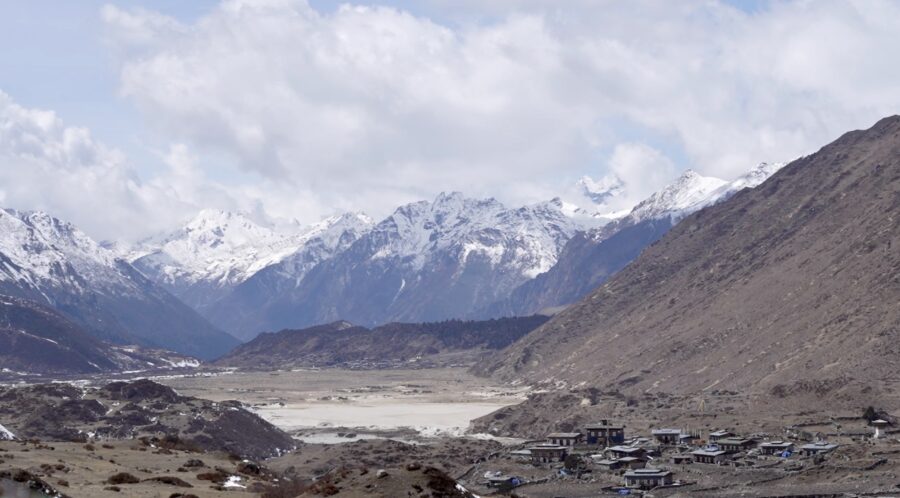
Beneath Thorthormi, one of Bhutan’s 17 potentially dangerous glacial lakes, is a quiet settlement. People there continue to work in their fields, trying to preserve a sense of normalcy while living between uncertainty and displacement.
For many families, life remains divided between two places.
In the warmer months, as the snow melts and the threat of a Glacial Lake Outburst Flood (GLOF) becomes imminent, they move across the river. They seek shelter under temporary tarpaulin sheds and huts in the relocated area. But as the temperature drops and winter grips the valley, families return to their old homes for warmth and reliable shelter.
One of the relocation sites for the people of Thangza is in Dungbiteng. Relocation, however, is proving far more difficult than expected. While residents here have access to basic materials like boulders and sand, a critical component is missing- timber. And without it, building permanent homes is not possible. According to residents, it would at least take two years to procure enough timber to build a house. Until then, settling here remains a challenge.
Dorji Wangmo, a resident of Thangza-Toenchoe said, “We are fortunate to receive land across the river from His Majesty. We also received tarpaulins to build temporary shelters. What’s challenging is demolishing our existing houses. Rebuilding similar ones in the new location will be difficult as timber is not easily available”
For many families, relocation is less about moving and more about whether rebuilding is even possible.
Dorji Wangmo said, “As things stand, perhaps only around 30 per cent of the people here are in a position to build new houses. Many families do not even own horses to transport timber. We do not know whether we will ever manage to build permanent homes there.”
Thangza-Toenchoe Tshogpa Nima Dorji said, “Rain seeps in when it rains, and strong winds make living conditions here difficult. Transporting timber also costs a lot. A horse takes almost an entire day to bring just two planks from Sangsha, and we pay around Nu 3,000 for a single trip. On top of that, we also have to pay those who help us fell the trees and transport the timber.”
Namgay Dorji, a resident said, “The charges to hire horses are exorbitantly high. We are already spending quite a lot on them to transport food supplies and manure in summer. And now, we have to worry about bringing in timber for the new houses. It will be difficult for us to manage.”
Behind every house left in the old settlement is also a lifetime of sacrifice.
Namgay Dorji added that “We spent all the money we earned from cordyceps on building these homes. We bought the CGI roofing sheets from Phuentshogling and painted our houses with traditional designs. Now we have to start all over again and there is no timber.”
Phurpa Dema, a resident said, “We can only afford to build shelters this small. Building bigger houses means spending more, and that too, just to transport timber.”
But the barriers are not only financial.
To some residents, dismantling these houses is beyond a physical task. It is a decision tied to faith, identity, and the environmental cost of rebuilding.
Thangza-Toenchoe Tshogpa Nima Dorji said, “Those with skills and strategy can dismantle their houses and rebuild them there. But these homes are not just structures. We have worshipped our deities here for generations. So, dismantling them could bring illness and misfortune to our family.”
Likewise, Namgay Dorji said, “Each household may need to cut at least a hundred trees to build a house. We already have an issue here; in fact, people everywhere plant trees to prevent floods, but imagine us cutting all the trees to rebuild our lives.”
For the community, alternative construction materials through the government’s support could help address their concerns.
Namgay Dorji added that “People here do not need big houses. With the government’s support, we can manage with single-storey structures. These days, we do not necessarily require timber for construction. People can use concrete blocks or other such materials.”
The Gasa District Administration is aware of the challenges. The Thangza-Toenchoe resettlement is listed as a priority project while the government explores a climate finance mechanism, the Loss and Damage Fund, created during COP27. The proposal, worth around Nu 953 M (USD 10.2M), includes the construction of climate-resilient houses.
Gasa Dzongda Jigme Namgyal said, “The government has prioritised this resettlement under loss and damage funding. The task force is working on this, and our resettlement project is one of the main components of this government proposal. So, if it comes through, then we will be able to assist them in providing modern housing materials, which can resolve timber issues.”
Besides, the district administration is also developing other permanent structures in the resettlement area. An ECCD centre was completed recently, which will be operational soon.
Meanwhile, as the government works to secure funds and develop structures, life for the people of Thangza-Toenchoe continues between two worlds – the home they cannot leave and the future they cannot yet build.
Devika Pradhan