
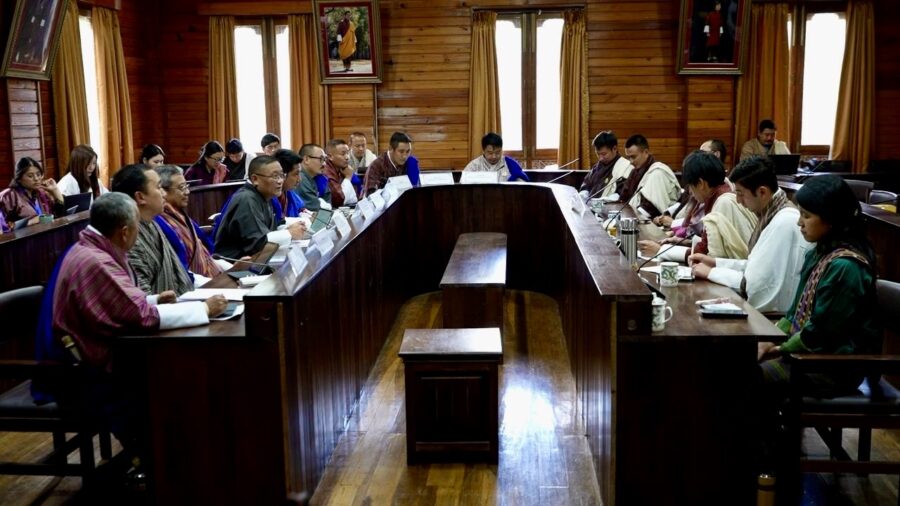
 The National Assembly is revisiting the way Question Hour sessions are conducted. The House is amending the Rules of Procedure of the National Assembly of Bhutan 2022. This was shared today during a press conference held by the National Assembly.
The Question Hour session is where Members of Parliament raise issues concerning governance, public service delivery, and national development. Currently, the Question Hour session is held every Tuesday and Friday.
According to the existing Rules of Procedure of the National Assembly of Bhutan 2022, a question is allotted three minutes, answers seven minutes, supplementary questions two minutes, and supplementary answers five minutes.
However, the National Assembly MPs said the objectives and structure of the session need to be defined more clearly to make the discussions more meaningful and effective.
According to the MPs, the session should not only serve as a platform for lawmakers to question the government, but also help create greater public awareness on government policies, national issues, and ongoing development activities.
Deputy Speaker Sangay Khandu explained that the proposed changes will bring clearer procedures on how Question Hour is managed, including limits on the number of questions and how debates can be initiated.
“The new Rules of Procedure will clearly specify how many questions will be permitted in a specific round. Another important provision is that if members are not satisfied with the answers, including supplementary responses, they may call for a debate. However, currently there is no clear procedure on how such a debate is approved, whether it is by the Chair, the Speaker or Deputy Speaker, or through a majority show of hands. We will therefore include this provision as well, including how many debates can be called in one session.”
He also added that the current timing structure of the Question Hour poses challenges, particularly when several supplementary questions are raised.
“During the Question Hour session, there is a provision for members to ask questions to ministers, but there is no limit on how many questions can be asked at one time. So, sometimes all the members raise many questions, and they cannot be accommodated within the session. As a result, there are instances where very few questions actually get taken up.”
He added that once the amendments are finalised, they will be discussed during a plenary session for adoption.
Meanwhile, the fifth session of the fourth Parliament will begin on Thursday.
During the month-long session, the National Assembly will deliberate on at least five bills, an agreement and a convention, Public Accounts Committee review report, State of the Nation report,s and Action Taken Reports.
Tashi Dekar