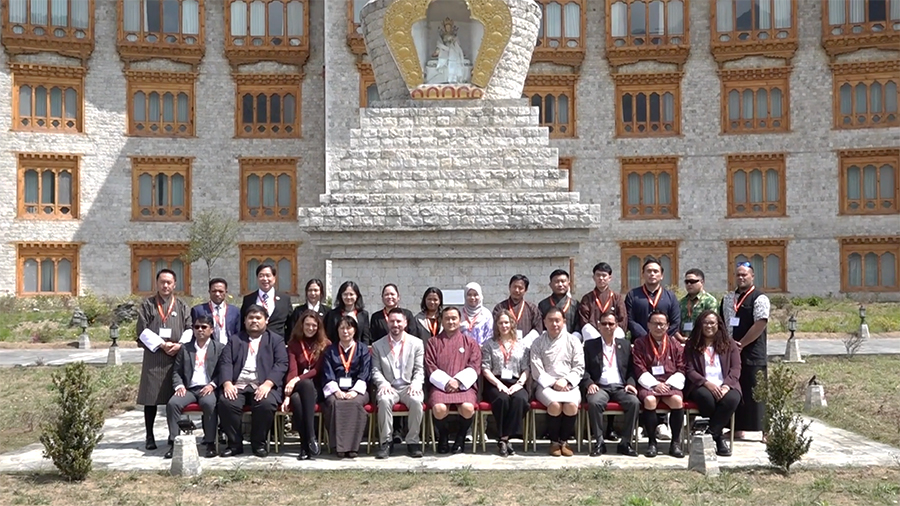
 Bhutan will step up efforts to better track and measure progress on climate adaptation. This comes after key gaps in monitoring systems were highlighted during a regional meeting currently underway in Paro. The issues were raised at a three-day peer learning event on Monitoring, Evaluation and Learning (MEL) systems for National Adaptation Plans. The government, with support from the National Adaptation Plan Global Network, organised the session.
The meeting brought together 26 participants from eight countries, including Bhutan, Cambodia, Malaysia, the Philippines, Thailand, Timor-Leste, Tonga, and Vietnam, to exchange experiences on how countries can better track adaptation progress.
Experts at the session highlighted a key challenge where, unlike mitigation, climate adaptation cannot be measured using a single global indicator. They said that progress varies widely depending on geography, sectors, ecosystems, and communities, making it difficult to compare or standardise results across countries.
“What we often see as a common mistake is that countries try to do everything at once. And that can be very challenging in terms of resources, capacities and also making sure that it is implemented and sustained. So, what we really suggest is for countries to have a phased implementation where they can start small, pilot, learn from the lessons and scale up,” said Emilie Beauchamp, Lead, Climate Adaptation Monitoring and Learning, Paro.
Another key concern raised was accountability. Without proper monitoring systems, experts warned that risk adaptation remains only on paper.
“Well, often when countries don’t measure adaptation and don’t track their progress, adaptation remains just a promise rather than going into implementation. Tracking adaptation allows countries to have accountability both for international and global reporting, but also accountability to their citizens and communities,” added Emilie Beauchamp, Lead, Climate Adaptation Monitoring and Learning, Paro.
For Bhutan, officials acknowledged that while adaptation work is ongoing, its tracking systems still need strengthening. At present, monitoring is largely carried out through Five-Year Plans and project-based reporting systems. However, these are not yet combined into one national system.
“Monitoring and evaluation is currently project-based or programme-based, and we are looking into ways to have an overall monitoring and evaluation system at the national level. We need to focus on how we can integrate our 13th Five-Year Plan with climate action, particularly the adaptation component, which will play a critical role in resource mobilisation for the future,” said Sonam Gyelpo, Lead, Climate Adaptation.
Bhutan currently reports its climate actions through international mechanisms under the United Nations Framework Convention on Climate Change (UNFCCC), including national communications and transparency reports. However, officials say growing reporting demands require more consistent and better-quality data.
The issue is also closely tied to climate finance. Experts highlighted that stronger monitoring systems are essential not only for accountability but also for accessing funding.
“These are the facts and figures through which we will be reporting, and they are critical for capturing climate action. This is also how, whenever we access resources from climate instruments, we can clearly show our requirements. It will be a helpful tool to strengthen our case,” said Sonam Gyelpo, Lead, Climate Adaptation.
Bhutan estimates it will need around 13.9 billion US dollars over the next decade to implement its National Adaptation Plan aimed at reducing climate risks and building resilience. Officials say this makes it even more important to build a robust and reliable monitoring system that can clearly demonstrate needs, progress, and impact.
For Bhutan, the focus now is on integrating fragmented systems into a unified national framework that can better measure, report, and strengthen climate resilience in the years ahead.
Karma Samten Wangda, Paro
Edited by Yeshi Gyaltshen