
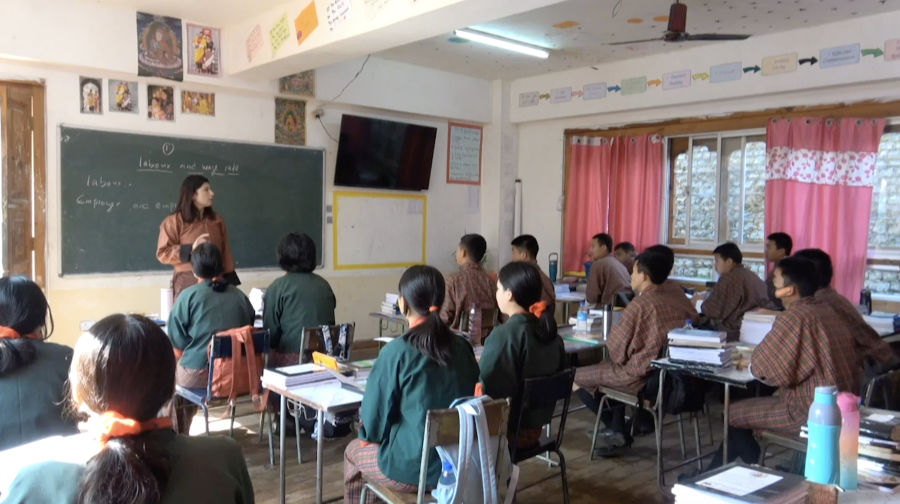
 With the new academic session this year, class nine and eleven students across the country will study a Cambridge-aligned curriculum for the first time. The Ministry of Education and Skills Development announced the rollout during the 21st National Education Conference, held recently in Trashi Yangtse. The curriculum reform follows the Royal Kasho on education reform, aiming to better prepare students for the future while preserving the country’s values, culture and identity.
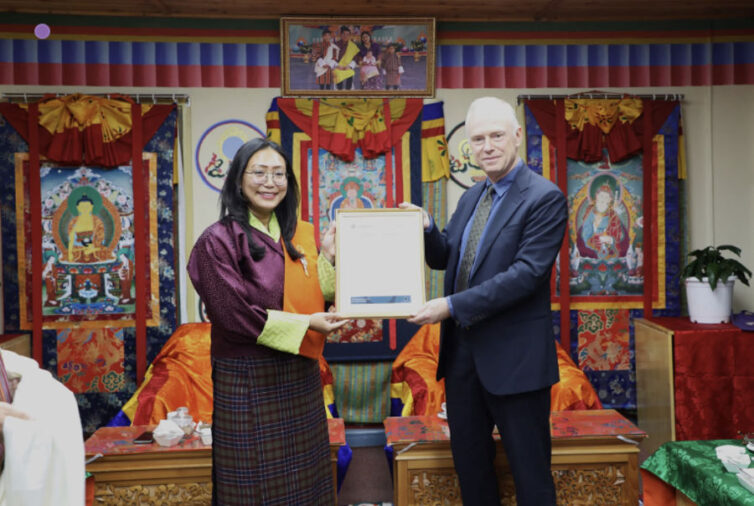
The Ministry has been working on the new curriculum since 2024. In October last year, the Chief Executive of Cambridge University Press and Assessment formally presented the Certificate of Alignment to the education ministry, confirming that Bhutan’s curriculum meets Cambridge standards for quality and learning.
It covers key subjects such as English, Mathematics, Science, Economics, Digital Technology and Innovation and other core subjects.
The alignment follows an extensive review and checking by both Bhutanese and Cambridge experts. More than 100 Bhutanese curriculum developers and teachers took part in workshops and training sessions to ensure the curriculum was well-designed and easy to teach.
The new Cambridge-aligned curriculum is a skill-based system focusing on 21st-century skills, digital technology and innovation.
“For the rollout in March this year, textbooks for all subjects in classes IX and XI are ready and will be introduced on a pilot basis. The books will be supplied to schools by March, after which we will collect feedback and suggestions from teachers and schools to further improve the materials,” said Norbu Wangchuk, Officiating Chief Curriculum Officer, MoESD.
For classes 10 and 12, the new Cambridge-aligned curriculum will be rolled out in the next academic session, while the remaining classes will be introduced in phases.
“Between March and May this year, we plan to develop textbooks for classes X and XII. Draft textbooks for classes PP to VIII have already been prepared, and we will now focus on revising and finalising them before the rollout,” said Norbu Wangchuk, Officiating Chief Curriculum Officer, MoESD.
Last year, during the winter Parliament session, Education Minister Yeezang De Thapa said that the class 10-cut-off point would be deferred indefinitely with the rollout of the Cambridge-aligned curriculum.
With over 100 new textbooks from classes PP to 12 in development, the ministry plans to rebrand the cut-off point as a ‘merit-based admission system,’ saying the old term carries negative connotations. The merit-based system will be based on the students’ performance and may be removed if it is not needed.
To strengthen teachers’ capacity, more than 2,500 teachers, covering 95 per cent of the total, have received the orientation programme. The remaining teachers will complete their training by the beginning of this academic session.
The three-day National Education Conference brought together more than 200 participants, including principals, district education officers, and officials from the ministry. The conference focused on strengthening the education system to meet the changing learning needs.

Sonam Darjay, Trashi Yangtse
Edited by Sonam Pem