
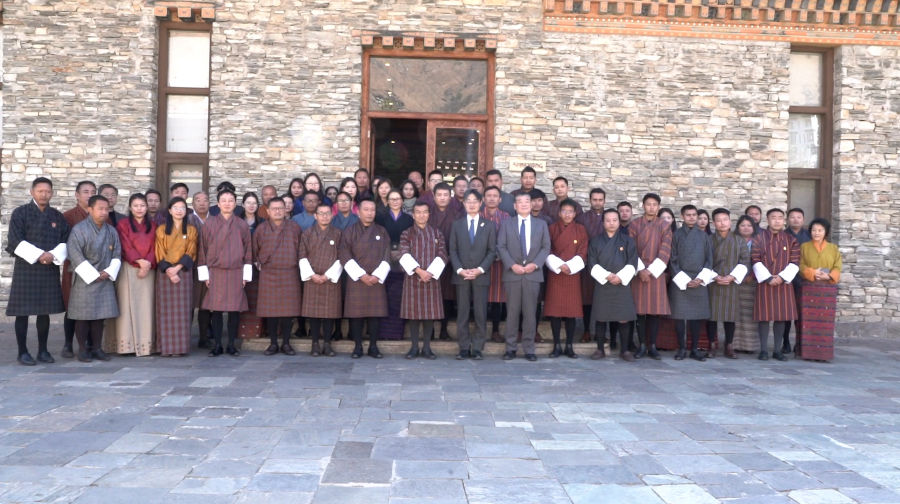
 Kaizen, a Japanese philosophy that focuses on small, continuous improvements every day, is slowly gaining ground in both state-owned enterprises and private firms in Bhutan. The finance ministry and Japan International Cooperation Agency piloted the initiative in the country in 2024.
Japanese experts say Kaizen is about not waiting for big transformations, but making steady improvements, whether at work, in factories, offices, or even in daily routines.
In practice, it often begins with simple changes such as reorganising files, materials, or equipment to make work easier and more efficient.
After the introduction of the philosophy, Bhutan Livestock Development Corporation’s processing unit was selected as one of the pilot sites.
The company’s CEO said the team delved in to try to find out the root causes of the problems.
He said that his workplace was initially crowded and disorganised, and the process began by sorting and arranging the clutter.
“Earlier, we did not have different crates for different meat items. So now we have red for pork and blue for chicken, so you can easily find out which one has chicken and which one has pork. And then the finished products are all stacked up. So we know exactly how many kilograms are in the store of a particular product. So this has made life very easy,” said Dophu Drukpa, the CEO of the Bhutan Livestock Development Corporation.
Although the outcome is little at first, it is expected to cut costs and save time in the long run.
Similarly, another state-owned enterprise and a private firm also started the implementation of the philosophy starting in October last year.
They presented the outcome of the last few months and pointed out some noticeable improvements, starting with waste reduction.
“One type of waste we identified was over-processing or over-collection, producing beyond market demand and overstocking. This has now been reduced. Because workspaces and items are better organised, movement and time spent between tasks have also decreased. Identifying and addressing these wastes has really helped us,” said Karma Dorji, the field supervisor of the Farm Machinery Corporation Limited.
“After the implementation of Kaizen, for my company, it has become a lot cleaner than other companies. So, for example, back then, we had no designated spaces for keeping all the scrap materials. But after Kaizen and learning about all five SS, we have designated a lot of areas for each individual section, and it has made the organisation a little bit cleaner,” said Dorji Khandu, Karma Tenzin Automobile Workshop.
He added that, in the long run, he is hopeful the improvements will help the company stay ahead of market competition.
With the pilot phase now complete, Kaizen is set to be rolled out across more organisations over the next three years.
There are also plans to establish a Kaizen centre in the country and include the philosophy in the academic curriculum through various institutions.
Devika Pradhan
Edited by Kipchu