
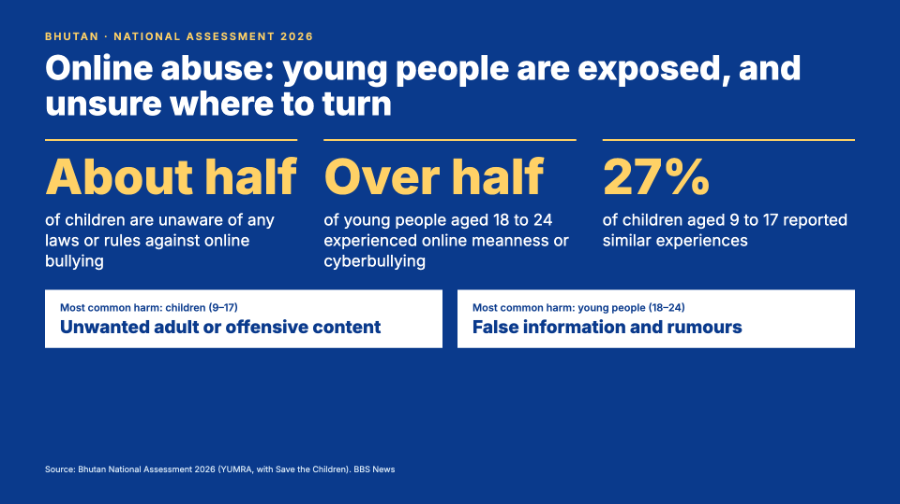
 About half of children in Bhutan are unaware of any laws or rules against online bullying. Many young people are also unaware of the protections available to them. A national assessment on cyberbullying and technology-facilitated violence and abuse has highlighted gaps in awareness and the need for stronger protection and reporting systems. The assessment was conducted by YUMRA, a youth-led group.
The assessment found that more than half of young people aged 18 to 24 experienced online meanness or cyberbullying. Among children aged 9 to 17, around 27 per cent reported similar experiences. However, knowing where to seek help remains a challenge.
Kesang Tshokey, Advocacy Campaign Communication and Media Coordinator with Save the Children, said addressing the issue requires involving children and young people in awareness programmes and finding solutions. “More than 90 per cent of the youth and children use digital devices. What we need to do is strengthen the system and conduct dialogue exchanges like today by engaging children and youth and asking them what the problems are and what needs to be done.”
The assessment also found that the types of online harm differ between children and young people.
Among young people, spreading false information and rumours online were rampant. Children most commonly reported receiving offensive messages or unwanted adult content.
The student group said schools and the country need stronger systems to report and protect children from cyberbullying.
Sonam Tshokee Wangmo, President of YUMRA, said children’s safety must also be considered in the digital space as they spend more time online. “It is really important for us to consider the space that we are growing in, especially cyberbullying. We may have policies that safeguard the safety of children but when the lives of children and young people are taking up so much space in the digital world, we also need to consider their safety there.”
The assessment calls for confidential and child-friendly reporting systems, clearer follow-up procedures and better training for teachers and counsellors to ensure children and young people feel safe reporting online abuse.
Sangay Chozom
Edited by Tandin Phuntsho