
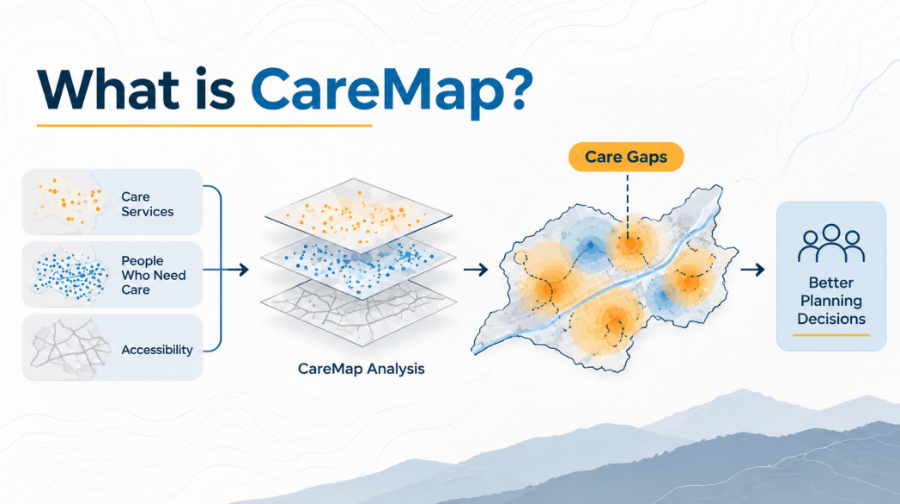
 Finding childcare near home, or an accessible facility for an elderly person or a person with a disability, is hard for many families in Thimphu. A new digital Care Map from Thimphu Thromde aims to make these services easier to find. It will also help authorities identify gaps and plan where more facilities are needed.
For working parents, having a childcare centre close to home can make a big difference. But many families in Thimphu still have to travel long distances to access care services.
According to the Care Map’s assessment, 35 per cent of children under five live more than a 10-minute walk from childcare services. For older persons, 44 per cent live more than a 30-minute walk from care facilities.
Kinley Wangyel, Deputy Chief Planner at the Ministry of Infrastructure and Transport, said, “Through the Care Map initiative in Thimphu Thromde, we have identified that many young women and mothers spend considerable time travelling to care facilities. Some live more than a 10-minute walk from these facilities, meaning they have to spend additional time travelling to access care.”
Distance, however, is not the only challenge. Of the 58 childcare services that reported their opening hours, only 10 operate throughout the typical working day, from 8:30 AM to 5:30 PM. None open on weekends.
For persons with disabilities, only eight of the 18 facilities have both ramps and accessible toilets.
Sudha Gooty, Regional Gender Advisor at the UNDP Bangkok Regional Hub, said, “We found in one of the areas in Thimphu Thromde that there are 18 disability care centres, but only eight of the 18 disability care centres have ramps and accessible toilets. So without these two facilities, persons with disabilities cannot use the care centres.”
The Care Map aims to make it easier for residents to find existing services. Through its public service finder, users can locate childcare, older persons’ care and disability services, check walking or driving times and get directions. They can also filter facilities based on step-free access.
For authorities, the platform provides a broader picture of where services are lacking and where existing facilities need improvement or expansion.
Kinley Wangyel said, “With this pilot project in Thimphu, we also saw that a lot of childcare facilities are required. And if we go by area, then the south of Thimphu and the northernmost part of Thimphu also require a lot of those care facilities.”
The assessment also found that Lungtenphu, Simtokha, Hejo Samtenling and Babesa account for a significant share of the city’s care needs. Together, these four areas are home to 39 per cent of children below five and 34 per cent each of older persons and persons with disabilities in Thimphu.
The Department of Human Settlements will maintain the platform, while Thimphu Thromde will use it to guide future planning and investment.
Karma Wangdi
Edited by Sangay Chezom