
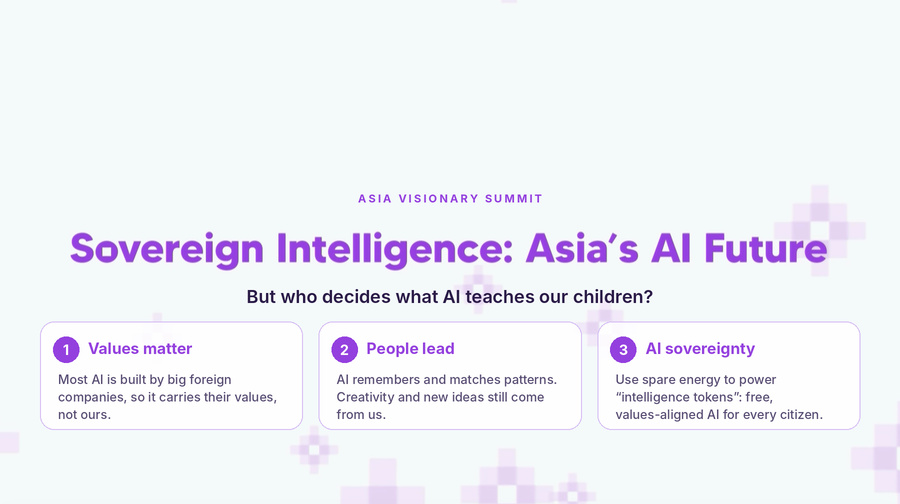
 Artificial intelligence is becoming part of our everyday lives, from how children learn to how people work and access information. But as Bhutan embraces the technology, how can the country ensure that AI reflects its own values, culture or priorities? This was among the key discussions at the Asia Visionary Summit, where speakers highlighted the need for countries to have greater control over how artificial intelligence shapes their future.
Over the years, AI has become increasingly common in Bhutan, with people using it for information, ideas and assistance in areas such as social media, education and workplaces. A recent international report ranked Bhutan among the top users of ChatGPT.
However, experts at the summit said the growing use of AI raises questions about who decides what the technology teaches, what information it provides and what values it promotes.

Most AI systems are developed by large international companies, meaning the technology often reflects the information, priorities and values of those who create them. Experts said this could become a concern, particularly as children increasingly rely on AI for learning and guidance.
Christopher Nguyen, CEO of Aitomatic, United States of America, said it was important for Bhutanese children to grow up with values that reflect their own society.
“When you teach Bhutanese children, when they go to school as a parent, would you like them to grow up with your values? I think the answer is universally yes. And so you don’t want an AI that, when you ask these questions, for better or for worse, gives a value that is aligned quite intentionally by a large 2 trillion US company,” he said.
Experts also stressed that AI should not replace human thinking. While the technology can provide information quickly, they said creativity, original ideas and independent thinking must continue to come from people.
Isaac Hall, Founder and Technical Fellow from California, said AI is good at remembering information and identifying patterns but has limitations when it comes to developing new ideas.
“AI is really good at remembering everything it’s ever read. And it’s basically pattern matching. But what it’s not good at is creating new information and new ideas. And so you really, as a student, need to study all of that so you can come up with something very noble, very new. So it’s up to you to add the creativity and the new understanding,” he said.
To address these concerns, experts highlighted the importance of AI sovereignty, which refers to a nation’s ability to develop, manage and make decisions about its own AI systems rather than depending entirely on technology developed elsewhere.
Nguyen suggested that Bhutan could use part of its available energy capacity to support AI services aligned with the country’s values.
“Bhutan has about something like 30 gigawatts of capacity, way more than it could ever use. Make some of that convert into intelligence tokens for its people using an AI that is aligned with your values,” he said.
One proposal discussed at the summit was to use part of Bhutan’s available energy capacity to support AI services through what experts call intelligence tokens. The tokens would provide every Bhutanese citizen with free access to AI intelligence and services, regardless of income.
The proposal could make AI more accessible to everyone while allowing Bhutan to develop technology that serves its own people.
Experts said achieving this would require collaboration, investment and the sharing of technological knowledge. Bhutan would not necessarily have to develop everything on its own but should have a say in how the technology is developed and used.
Singye Dema
Edited by Sonam Pem