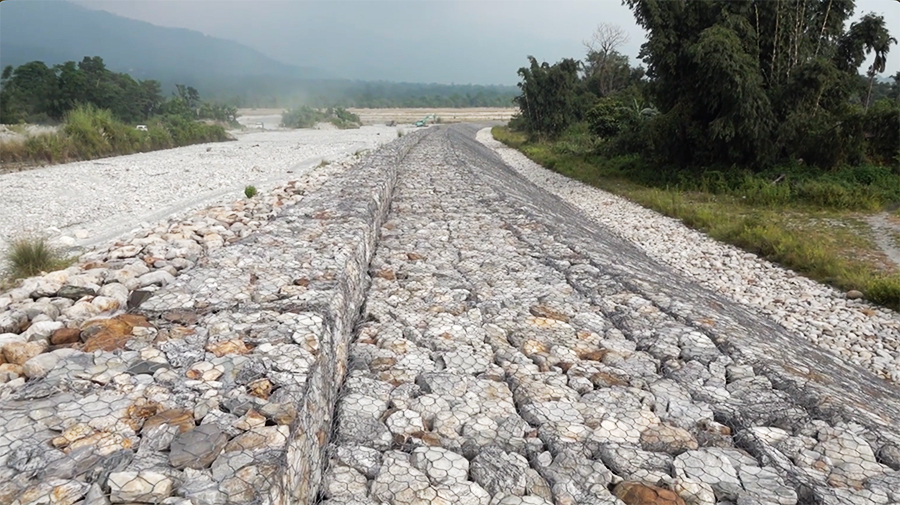
 Gelephu’s flood protection project is now complete, with the government formally handing over the completed works to Gelephu Mindfulness City today. The project strengthens four vulnerable river stretches in Sarpang that have faced flooding and erosion. The protection comes as Gelephu prepares for rapid urban growth under the Mindfulness City initiative.
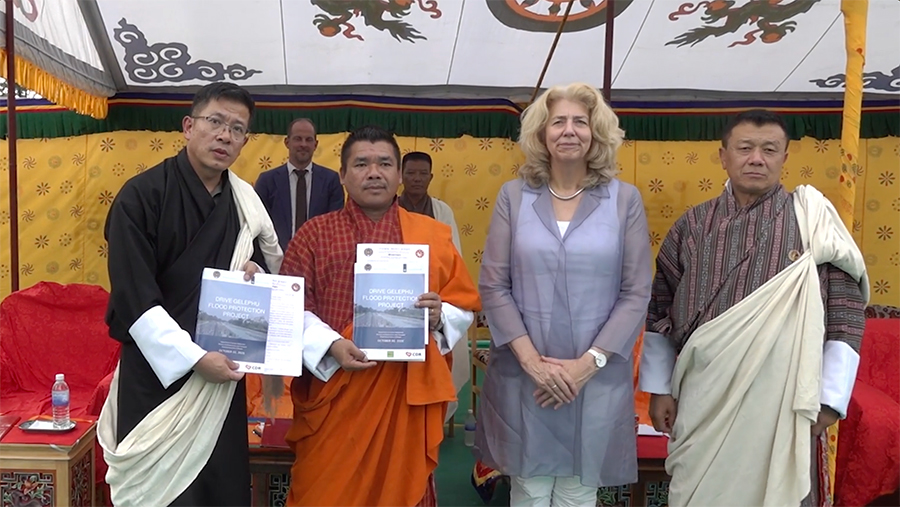 A project years in the making has now been handed over. The Ministry of Infrastructure and Transport formally transferred the completed Gelephu Flood Protection Project to Gelephu Mindfulness City today.
For the Ministry, the timing could not be more important. As Gelephu grows into the Mindfulness City, protecting the land and infrastructure on which that growth will take place is becoming increasingly important.
“As Gelephu transforms into a Gelephu Mindfulness City under the visionary leadership of His Majesty The King, the city will increasingly become an important centre for economic activities, investments, infrastructure and a gateway connecting Bhutan to the region and worldwide. Residents and investors must have confidence in the land on which it is being built. Gelephu Flood Protection Project therefore provides an essential foundation for this Project,” said Chandra Bdr Gurung, MoIT Minister.
Gelephu Mindfulness City officials see the project in much the same way, a basic requirement for a city that is expected to grow rapidly.
“A mindful city must first be a safe city. For the city that we are building, this project lays a strong foundation. Rivers and waters will always be the heart of Gelephu, and with the right protection and care, they can remain a source of life and beauty rather than the source of fear and destruction,” said Sonam Wangdi, MD, Sustainability and Environment Group, GMCA.
The project protects four vulnerable stretches in Sarpang: the Shetikhari and Mao rivers, the Thewar stream near Shershong School, and the Jogi stream near the army camp in Pelrithang. The works include riverbank protection and measures to improve river flow and reduce erosion and scouring.
But this was not a project that happened overnight. The idea dates back to 2015, following concerns over flooding in Gelephu. The Netherlands came on board through Dutch Risk Reduction support, helping with technical expertise, feasibility studies and project development. Physical construction under the DRIVE Gelephu Flood Protection Project began in August 2024 and was completed in August this year.
Today, the result is visible along the riverbanks. But officials are clear that flood protection cannot stop with these walls.
Gelephu’s rivers are interconnected, and flood risk extends beyond the areas covered by this project. Both sides say the next step will be to look at the wider river system, strengthen flood-risk planning and improve river and sediment management.
There is also scope for nature-based and hybrid approaches as Gelephu continues to develop.
Passang Dorji/Karma Wangdi, Gelephu