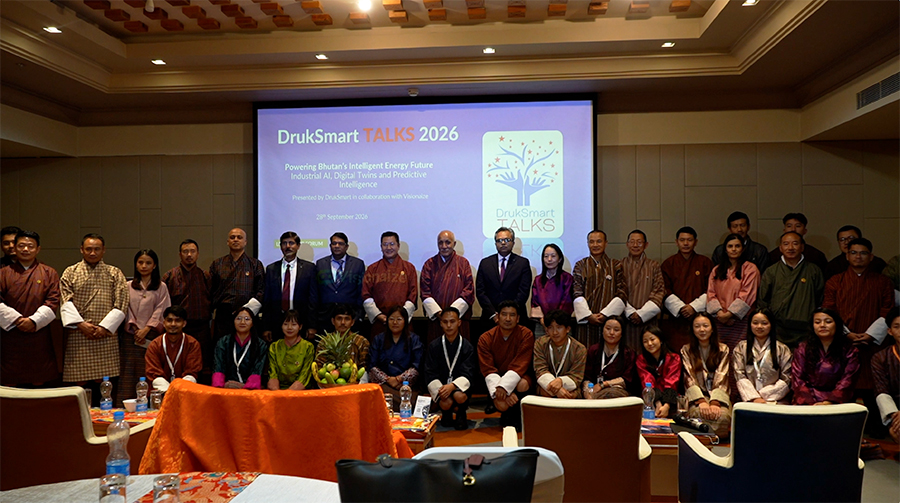
 What if a hydropower plant could warn operators that a turbine is developing a fault before it actually breaks down? Or predict a drop in water availability and a rise in electricity demand before they become a problem? At DrukSmart Talks 2026 yesterday, technology experts explored how artificial intelligence could help Bhutan spot these problems, plan ahead and make better use of its energy resources. Established in 2017, DrukSmart is a Bhutanese IT and IT-enabled services company.
For Bhutan, the challenge is not simply generating electricity. It is keeping critical equipment running, anticipating changes in water availability and demand, and making decisions before problems turn into costly disruptions.
At DrukSmart TALKS, technology experts demonstrated how Industrial AI, Digital Twins and Predictive Intelligence could help move the energy sector from reactive maintenance to predictive decision-making.
Instead of waiting for a machine to fail, the system can look for unusual changes in how it is working and alert operators that something may be wrong. That could give them time to inspect the equipment, carry out maintenance and avoid an unexpected shutdown.
“Till now, our operators only monitor. As our AI technology develops, the industrial assets are getting lots of data. We analyse the data and build intelligence, so we can do predictive maintenance,” said Pema Tshering, CEO & Founding Partner, DrukSmart.
With water availability affecting hydropower generation, and demand fluctuating across seasons, predictive systems could help agencies plan generation and electricity supply more effectively.
This could be particularly relevant during winter, when domestic hydropower generation falls, and Bhutan relies more heavily on electricity imports.
“During winter, there are power shortages, and we have to import, which is costly. If we have AI monitoring, we can do proper planning and do accordingly,” said Pema Tshering, CEO & Founding Partner, DrukSmart.
The technology could also be used beyond power plants, helping monitor transmission lines, substations and distribution infrastructure, potentially giving operators a broader picture of the health of the power system.
“Globally, where the products have been deployed in heavy industries and critical infrastructure, and the energy industry, plant operators have experienced lower downtime and efficiency increases, which reduces the cost of production,” said Vikas Agrawal, CEO, Visionaize.
But bringing the technology to Bhutan will require more than installing new systems. Experts say the first step is identifying where it can solve a real operational problem, determining whether the necessary data is available, and testing it through focused pilot projects. And as Bhutan explores these technologies, there is also a focus on building local skills to use and manage them.
“There is a dual agenda to have these latest trending technologies implemented for our sector here in Bhutan, as well as having the local manpower trained,” said Avinash Sanap, Chairman & Partner, DrukSmart.
For Bhutan, the promise of AI is not simply about using new technology. It is about seeing problems earlier, planning better and making the most of the energy resources the country already has.
Anita Chettri
Edited by Sonam Pem