
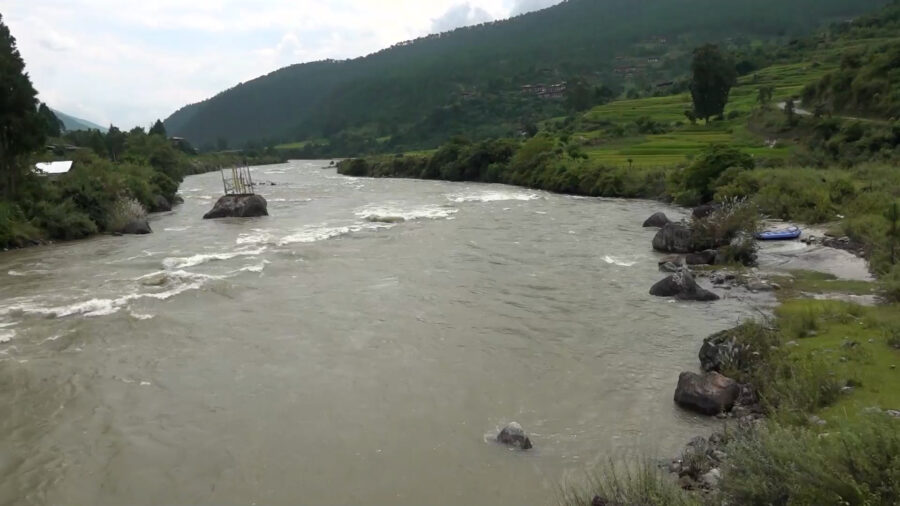
 Awareness of the risk of another Glacial Lake Outburst Flood, GLOF has made residents of Samdingkha in Punakha more alert and prepared. The community has an evacuation centre, an early warning siren and plans in place, but residents say the fear remains, particularly over whether they will have enough time to escape if a flood strikes at night.
Samdingkha in Toewang Gewog sits along the Phochhu, in one of the areas considered most vulnerable to a glacial lake outburst flood. The community was flooded during the 1994 glacial lake outburst flood from Lugge Tsho in Lunana in Gasa. At the time, there were fewer settlements and no casualties were reported, although several acres of farmland were damaged. Today, around 40 houses and shops, with about 75 residents, are located in the area. Around seven acres of agricultural land are also at risk
Following awareness programmes, residents now know the evacuation route and where to go when the warning siren sounds.
A support group has also been formed to assist elderly people and people living with disabilities during an emergency. The gewog administration has discussed keeping essential food items ready in case families need to evacuate.
Bjibjokha-Uesarkha Tshogpa Penjor said, “A siren has been installed on the hilltop of Bjibjokha village and will sound if there is a flood. We advise residents to leave immediately after hearing the siren and take only essential and valuable belongings. The evacuation centre has already been identified, and residents have been informed about it. We continue to remind people to stay prepared and act immediately when a warning is issued.”
The National Centre for Hydrology and Meteorology has installed 17 siren stations and seven Automatic Water Level Stations along the Phochhu to monitor potential GLOF events and warn downstream communities.
The centre’s in-charge in Wangdue Phodrang, Dechen Pelden, said, “If any of the four lakes reaches the alarm level, the sirens in the upper region of Lunana will activate automatically. If the station at Dangsa reaches the alarm level, the sirens in the lower region will also activate automatically. We can also trigger the sirens manually from our control centre. Most of the systems are functioning well, and I am hopeful they will help during an emergency.”
The warning system gives residents a clear signal to evacuate. But it has not removed their fear of another flood.
“I stay alert by listening to the river. Last year, the river flooded, and I noticed a bad smell coming from it. Since then, I often step outside and check for any unusual smell. I also listen for the siren. I hardly sleep at night and often stay awake, watching for any signs of danger,” said Namgay, a resident.
Another resident Pem, said, “If a flood occurs during the day, I think we can escape by informing and helping one another. But I worry about what might happen at night. I am staying in Samdingkha for now, but I am building a small hut at Wangkha and plan to move there. I have already packed my belongings. I trust the siren, so I keep listening for it. Because of this fear, I cannot sleep peacefully at night.”
Some families have moved valuable belongings to safer places. However, residents remain concerned about whether the warning will come early enough for everyone to get to safety.
“People may be able to escape during the day, but it could be much more difficult at night. The designated evacuation centre is also quite far, and residents may have difficulty finding transport to reach safety,” said Lam Dorji, also a resident.
Residents say this monsoon will pass, but the Glacial Lake Outburst Flood risk remains. And when danger comes, they know they must move as soon as the siren sounds.
Changa Dorji
Edited by Passang