
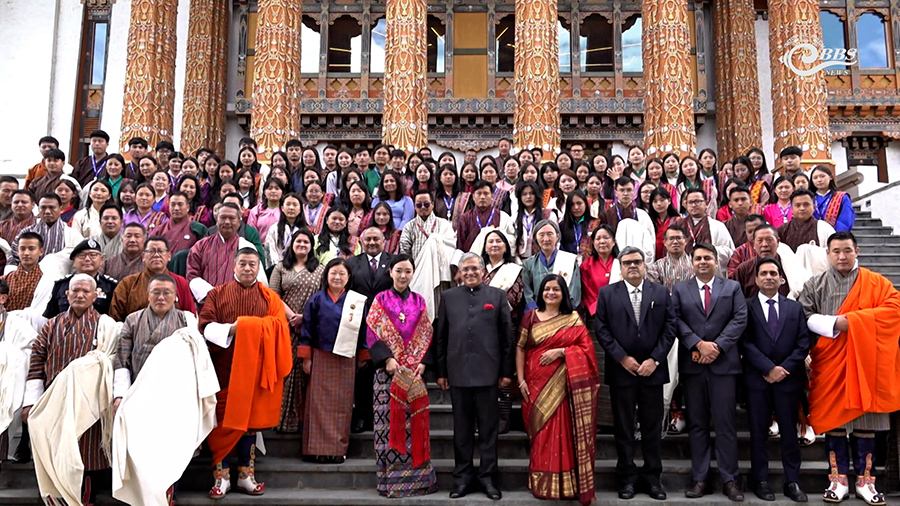
 Marking National Voters’ Day celebration in Paro today, the Election Commission of Bhutan launched four initiatives to strengthen election administration and improve voter participation. The launch comes as the country prepares for the second phase of the fourth Local Government Elections, following low turnout in the recent Thromde elections, particularly among young voters. Her Royal Highness Princess Sonam Dechan Wangchuck graced the celebration.
Officials during the event shared how the recent Thromde elections offered the Election Commission a clear indication of where Bhutan’s electoral system needs greater attention.
According to the Election Commission’s Thromde Election Report 2026, only 33.92 per cent of registered voters cast their ballots in the first phase of the fourth Local Government Elections.
Participation was lowest among young voters. Of 3,518 people who voted, only 280 were between 18 and 24 years old, accounting for 8.17 per cent of all votes cast.
Moreover, the report identifies several areas that need attention before the next phase, including voter education and participation, accessibility, building capacity of election officials, and the need to improve accuracy and consistency of electoral data.
The initiatives launched in response to some of these needs include a Strategic Roadmap developed with the Office of Cabinet Affairs and Strategic Coordination, the Election and Results Administration System, which was piloted during the Thromde elections, the Thromde Election Report 2026, and an e-Learning Course developed with the Anti-Corruption Commission for election officials, Returning Officers and National Observers.
The Thromde Election Report 2026 says the pilot Election and Results Administration System highlighted the importance of institutional coordination, timely communication, trained personnel and reliable technology. It says the experience will be used to refine the system ahead of the second phase of the local government elections.
The event also highlighted how improving election administration is only one part of the challenge.
The same report points to the need for wider participation, particularly among women and young people.
“As a first-time voter, voting gives me the opportunity to contribute to the Bhutan I hope to see for generations to come. It is also a chance to have my voice heard and take part in shaping my country. It feels like an important responsibility because my vote represents my values, my hopes, and the future I want to see,” said Chimi Wangmo, a student of Shari Higher Secondary School in Paro.
For first-time voters, participation is also about understanding the choices being made and the responsibility that comes with exercising the vote.
Another student of the school, Jigme Dorji, said, “From the politicians, I expect them to be honest, responsible and committed to serving the people. I hope they will hear the voices of younger people, create better opportunities and employment and work towards a more prosperous Bhutan. More importantly, I hope they keep their promises and put the interest of the people above themselves.”
The second phase of the fourth Local Government Elections is scheduled for early next year.
Now, the test for the new initiatives will be whether they can help turn electoral participation from a formal right into something more citizens choose to exercise.
Karma Samten Wangda, Paro
Edited by Phub Gyem