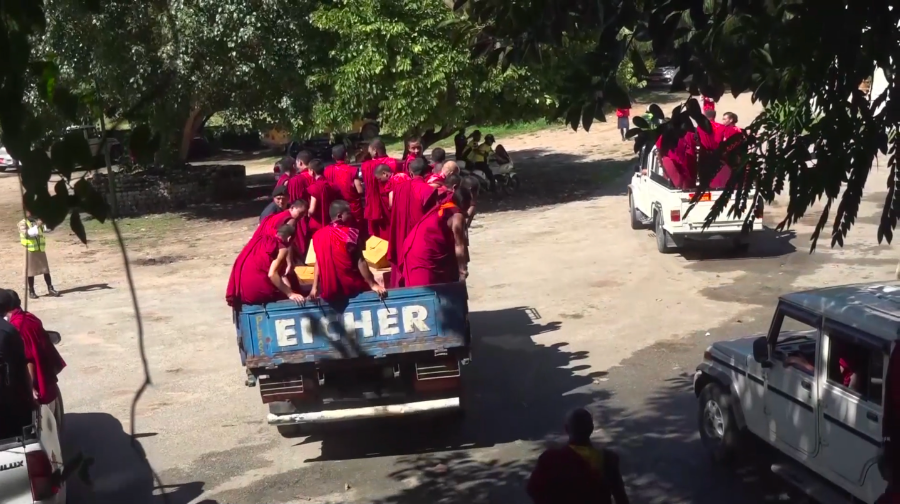
 The 1994 glacial lake outburst flood in Punakha claimed several lives and damaged property, including the Punakha Dzong when it swept through the valleys downstream. More than three decades later, the danger still looms large. Despite mitigation efforts, climate change is accelerating glacial retreat, making the glacial lakes in Lunana highly unstable. While it is impossible to predict when a GLOF will occur, communities downstream can always prepare and remain vigilant. To test emergency response and evacuation preparedness, a GLOF Evacuation Drill was carried out in Punakha.
62-year-old Dema from Mendagang village was a labourer working at the Punakha Dzong Renovation Project along with her husband and three children. She was around 30 years old when the Luggye Tsho Glacial Lake Outburst Flood hit Punakha in October 1994.
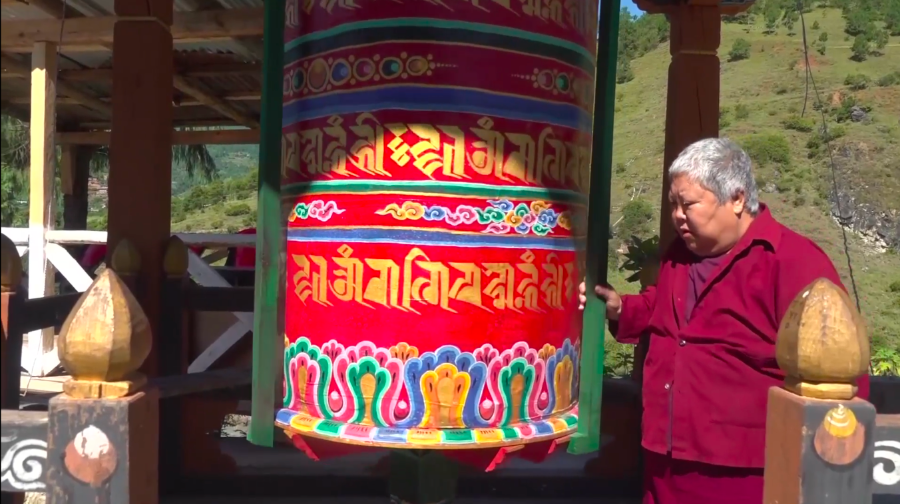 She recalls that by the time she became aware of the flood, Punakha Dzong was almost surrounded by floodwaters, making it risky to escape.
She recollects entering the dzong while carrying her daughter, along with other workers and climbing to the Utse, the central tower of the dzong, for safety.
Dema says the screaming of fellow workers because of extreme fear still echoes in her mind. From the Utse, she witnessed four people being swept away by the floodwaters.
“A girl was swept away right before our eyes along with a bridge,” recalls Dema.
“Likewise, there was a man called Ap Tela, a huge man wearing a red shirt. He was carrying a box. While the rest of the people managed to escape, Ap Tela could not. He was swept away by the flood along with the box he was carrying,” she adds.
Darchung, a resident, said, “All the labourers were staying at the place where the Shedra stands today. During the flood, some people were swept away while trying to escape. Some were swept away from the Dzongchung side while attempting to cross the river.”
The 1994 GLOF released about 18 billion litres of water, equivalent to more than 7,000 Olympic-sized swimming pools.
The flood reached Punakha in about seven hours, sweeping down the Phochhu and Punatsangchhu and damaging homes, farmland and infrastructure. More than 20 people were killed, making it one of Bhutan’s most devastating natural disasters.
The flood also damaged some parts of Punakha Dzong.
However, the risk has never completely gone away. The threat still looms, creating fear and speculation among communities, particularly those living along the Phochhu basin.
Thorthormi glacier lake in Lunana, which is melting rapidly due to global warming, sits above the Raphstreng lake, separated by an unstable moraine dam. Experts have warned that in the worst-case scenario, if the rapidly melting Thorthormi overtops into Raphstreng, the combined breach could result in a GLOF that could be three times disasterous than the 1994 flood.
The Glacial Lake Outburst Flood Evacuation Drill is testing the emergency response and evacuation preparedness of the Punakha Dzong. It also identifies gaps that need improvement to ensure timely and effective evacuation in the event of a worst-case scenario.
Built nearly four centuries ago, Punakha Dzong is one of Bhutan’s most important historic landmarks.
“It is possible to make mistakes since this is the first time such a mock drill is being conducted,” said Yang Dorji, Sr. Chief Programme Officer with the Department of Local Government and Disaster Management. “If we identify these mistakes today, we can correct and improve them immediately so that the lessons learned can help us conduct the drill more effectively in the future, especially when faced with a real situation. Therefore, it is important to identify and correct the mistakes from today itself. Our office is also recommending that the District Administration conduct such mock drills at least once a year”
Chief Engineer for NCHM, Tashi Namgyal said, “There is a risk of a worst-case scenario if Thorthormi and Raphstreng Lakes merge. The floodwaters from the breach of these two lakes would allow very little time for people of Lunana to respond. However, it could take around two hours for the flood to reach Lhedi, and around five and a half hours to reach Samdingkha in Punakha. In total, it could take around six hours for the flood to reach Punakha Dzong. Of course, we have prepared this estimated timeline in case such a flood occurs.”
However, he said that the arrival time of floodwaters may vary depending on the volume of water discharged, the nature of the flood, and the landscape through which the floodwaters flow.
Officials from the National Centre for Hydrology and Meteorology say that adequate early warning systems have been put in place and are urging the public to remain vigilant.
While disasters cannot always be prevented, their impacts can be reduced through regular drills and preparedness. For Punakha Dzong and communities living downstream, such preparedness could make a difference between loss and survival.
Changa Dorji, Punakha
Edited by Phub Gyem