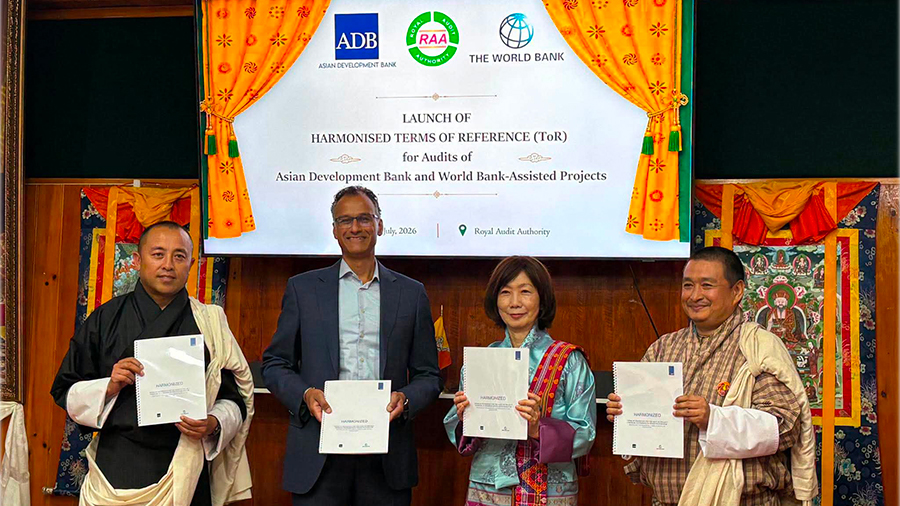
 Development projects funded by the Asian Development Bank and the World Bank will now be audited under a single framework. The Royal Audit Authority, in collaboration with the two development partners, launched the new common audit framework today. The new Harmonised Terms of Reference aim to simplify audits, reduce duplication, and strengthen accountability in the use of development funds.
Until now, projects funded by ADB and the World Bank followed separate audit requirements, meaning auditors had to work with different procedures and reporting standards.
For instance, if ADB funded a road project, auditors followed ADB’s audit guidelines. If another project, such as a school or health facility, was funded by the World Bank, auditors followed a different set of requirements.
During the 2024-25 financial year, audit interventions helped save or recover Nu 184.458 M in public funds, according to RAA’s annual performance report 2024-2025. This included Nu 6.325 M refunded directly to the Asian Development Bank after auditors found that the amount had been incorrectly claimed or paid under an ADB-funded project.
With the new harmonised Terms of Reference, auditors will now follow one common approach for both ADB- and World Bank-supported projects.
“So basically, both the ADB and the World Bank have specific requirements to fulfil. The Terms of Reference include all those requirements and guide auditors on what areas to look into, what the minimum requirements are, and what needs to be reported. In this way, we will be able to satisfy the requirements of both the World Bank and the ADB, while improving the quality of audit reports,” said Dorji Wangchuk, Joint Auditor General, Royal Audit Authority.
He added that the new framework will help protect public resources while improving confidence in development financing.
“Based on this revised Harmonised Terms of Reference, we look for consistency in our auditing approach and ensure that minimum reporting requirements are addressed. This will provide better assurance to donors on the use of their resources and ultimately strengthen transparency and accountability in public spending. In this way, it will improve the quality of auditing,” said Dorji Wangchuk, Joint Auditor General, Royal Audit Authority.
For project implementing agencies, the new framework means fewer administrative hurdles and reduced duplication.
For auditors, it provides clearer guidance on what to examine and how to prepare reports.
And for citizens, it provides greater assurance that public resources and development funds are being managed responsibly.
The Harmonised Terms of Reference are expected to be implemented within this fiscal year.
Tashi Dekar
Edited by Sonam Pem