
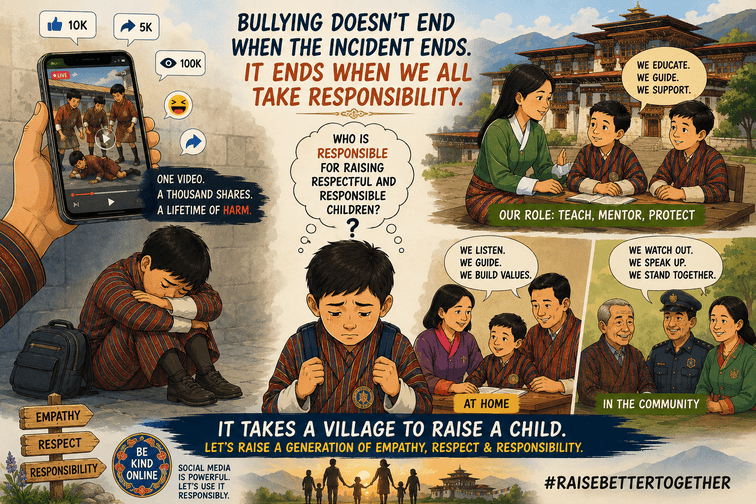
Bullying in schools is not new. But today, the harm doesn’t stop when the incident ends. In the age of social media, a single video can be shared a thousand times within minutes, turning a private act into a public spectacle. This is what happened in the recent school bullying incident. But beyond the videos lies a bigger question. Who is responsible for raising respectful and responsible children? Is it the school alone, or do parents and the wider community have an equal role to play?
The recent bullying incident came to public attention after videos of the assault circulated widely on social media. The incident has since sparked a national conversation, not just about bullying but about accountability.
Education and Skills Development Minister Yeezang De Thapa, during yesterday’s Meet the Press session, said accountability does not rest solely with schools and teachers.
“Since it happened in the school, we take the accountability. But when it comes to a child’s behaviour, that responsibility belongs to all of us. It is said that it takes a village to raise a child. The first responsibility begins at home. So, I want to ask every parent: Are you fulfilling your responsibility? Are you guiding your children? Whenever incidents like this happen in schools, we question the ministry, the teachers and principals. But have we ever asked parents what they have done to build a strong relationship with their children?”
According to the minister, even the parents of the students involved were unaware of what had happened until the incident surfaced online.
The minister added that the videos were circulated for likes, views, and online attention. This, the minister said, has renewed discussions on the need for greater responsibility in how minors use social media.
“I feel that social media is influencing our children’s behaviour. This incident should be an eye-opener for the government, policymakers, and all of us. Isn’t it time to consider restricting social media access for minors? Even in the Lungtenzampa case, the students planned the incident, recorded it and uploaded the video themselves. Why? Because they wanted more views, more likes and online attention. Social media has a powerful influence on young people. Isn’t it time for the government to consider a ban on social media for minors, similar to what Australia has done?”
At the school level, the ministry said prompt disciplinary action was taken. The students involved were suspended and barred from sitting their examinations.
But the ministry says punishment alone is not enough. Its approach focuses on restoring the wellbeing of everyone affected, including the victim, perpetrators and witnesses, through counselling and rehabilitation.
The incident is under police investigation, and the ministry has yet to receive updates on the outcome. However, the minister clarified that it is not a criminal case.
Looking ahead, the ministry plans to strengthen its School Health and Wellbeing Strategy by revamping the Mentor-Mentee Programme and providing structured mentoring training for all teachers starting next year.
The videos may have exposed one act of bullying. But they have also exposed a deeper challenge. Education is more than academic achievement. It is about raising children who know empathy, respect and responsibility. Those values begin at home, are reinforced at school and are strengthened by the community. So, preventing the next bullying incident, according to Minister Yeezang, will require all three to work together.
Sonam Yuden & Tashi Dekar
Edited by Sonam Pem