 Lower tax revenue and higher government spending are expected to widen Bhutan’s fiscal deficit in the coming year. According to the World Bank, the fiscal deficit is projected to reach 3.7 per cent of GDP this financial year, up from 2.6 per cent last year.
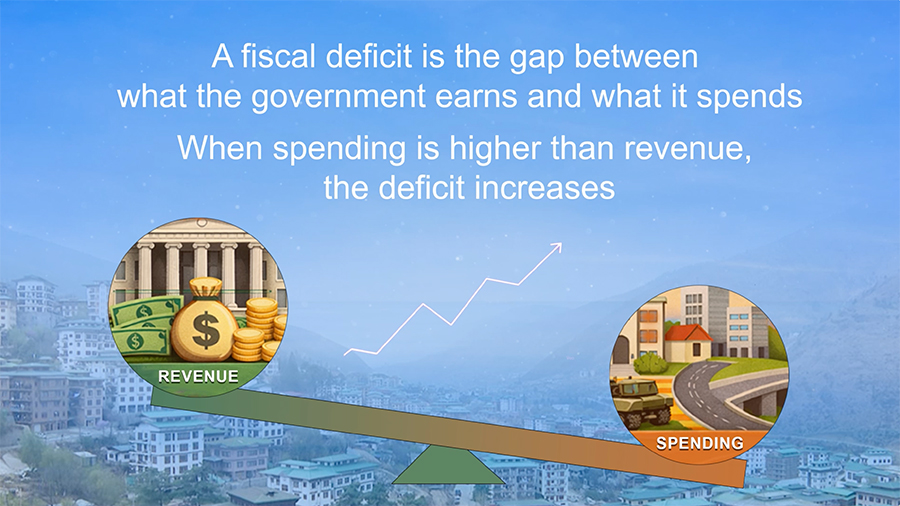
A fiscal deficit is the gap between what the government earns and what it spends. When spending is higher than revenue, the deficit increases.
The World Bank says Tax revenue is expected to grow more slowly than government spending. This could widen that gap.
Bhutan introduced the Goods and Services Tax (GST) to improve revenue collection. As of early March this year, the Department of Revenue and Customs collected more than Nu 1bn from GST.
However, the government has also reduced corporate and personal income tax rates. According to the report, these tax cuts are partly offsetting the gains from GST.
The government introduced the tax reforms to support economic growth. Over time, the World Bank expects the reforms to encourage more private investment and higher consumption, which could help improve revenue collection.
Government spending, however, is also increasing.
Bhutan is spending more on development projects, which has raised capital expenditure. At the same time, fuel subsidies are adding pressure on public finances. The Prime Minister’s Office estimates that fuel subsidies cost about Nu 1.4bn every month.
Because of this, the fiscal deficit could rise by an additional 0.4 percentage points compared with earlier projections.
Meanwhile, Bhutan’s public debt remains high. It could reach over 112 per cent of GDP by the end of the 2025–2026 financial year.
Samten Dolkar
Edited by Sangay Chezom