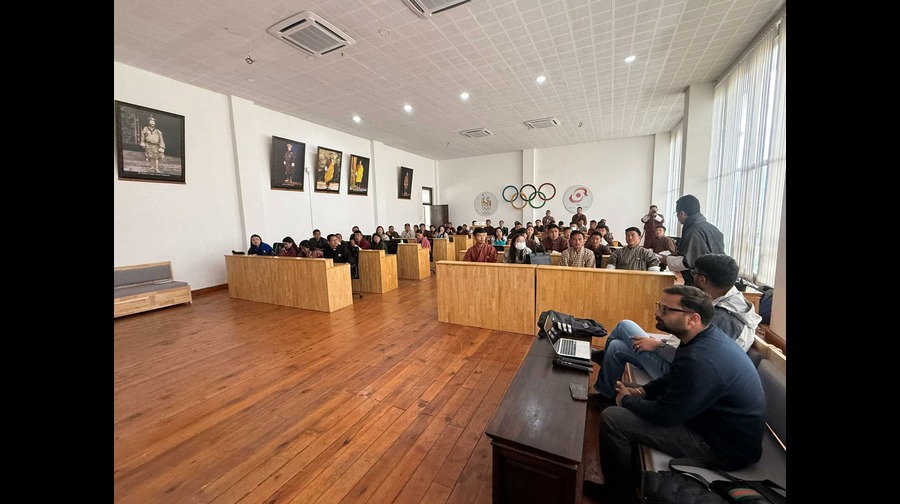
The country is rolling out a new Paralympic sport in Special Educational Needs or SEN schools. Boccia, a game for students with cerebral palsy and severe physical disabilities, is set to give young athletes more chances to play and compete. For that, a three-day Boccia technical training is underway in Thimphu.
Boccia is a ball sport where players or teams try to throw or roll their balls as close as possible to a small white target ball called the jack.
Players can also block or knock away their opponent’s balls.
Points are awarded for each ball closer to the jack than the opponent’s, and the one with the most points after several rounds wins.
It is played on a flat court and designed for athletes with physical disabilities.
Jaspreet Singh Dhaliwal, a trainer at Boccia Technical Training Programme said, “It is very helpful for athletes who want to participate in or are interested in playing Paralympic sports. It is also beneficial for society because children in primary schools can play Boccia. It is a sport similar to chess—a mind game. So, I think it is very good for people with disabilities in Bhutan, as well as for Bhutanese society.”
The first phase of the training includes participants from 24 SEN schools across the country.
Sonam Deley, a teacher at Tshenkharla Central School, Trashi Yangtse said, “This is my very first time attending in this Boccia training technical training programme and I would like to learn as much as I can and implement it back in my school.”
Geley Dema, a teacher at Phuntsholing Rigsar Higher Secondary School said, “I would like take all the skills back to my school and community to help our students succeed. And I plan to share with other coaches as well so that we can grow sports together and ensure all the athletics has a right to play.”
The Bhutan Paralympic Committee will be providing two sets of Boccia balls to each participating school to help introduce the sport at school level.
The Bhutan Paralympic Committee plans to expand Boccia to all SEN schools in the country in the next phase.
There are currently 50 Special Educational Needs schools with more than 1,400 students across the country.
With the new para-sport, students with disabilities will have more opportunities to play, compete, and be part of the country’s growing para-sports movement.
Karma Wangdi