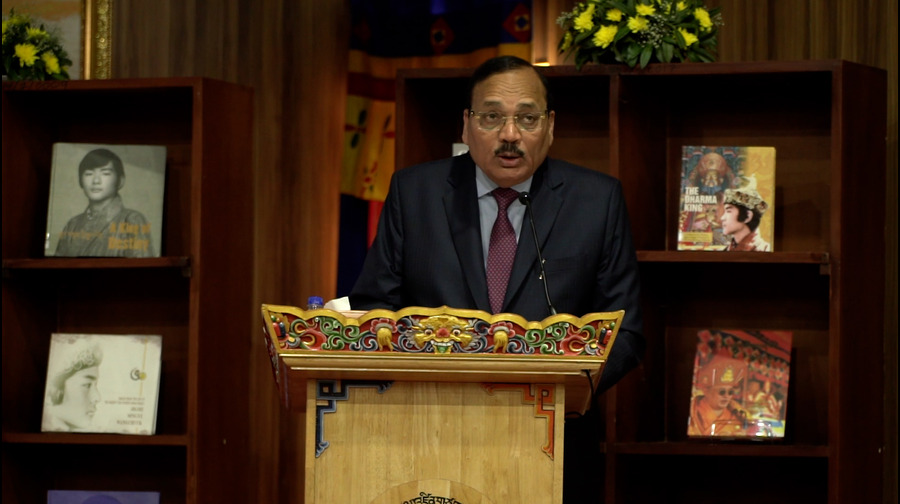
The Chief Justice of India who is on a four-day visit to Bhutan said technology is already reshaping the justice system in India, with e-courts and virtual hearings. Surya Kant, the Chief Justice of India shared this at the Wisdom for the Future Talk Series in Thimphu today. He said this is helping make legal services more accessible, transparent, and efficient for citizens replacing traditional court procedures.
Traditionally, court processes rely on physical files, requiring individuals to be present in courts physically and written judgments.
These procedures created structural barriers for many people, particularly the poor who had to travel long distances and navigate complex legal procedures.
During the talk, the Chief Justice of Indiasaid technology is now transforming the way courts function.
Digital innovations such as e-filing and virtual hearings are changing this landscape. By removing geographical barriers, these systems allow people to access justice without being physically present in courtrooms.
The Chief Justice of India said, “Citizens no longer need to navigate the physical and procedural complexities of the courts. They can track the progress of their cases from home. With digital mediation, this technology has become the greatest equalizer, bridging the gap between the law and the lives it is meant to serve.”
However, he said that it should not undermine human dignity and due diligence in handling cases.
He said digital tools, including online legal libraries and AI-assisted translation systems, are helping decentralise legal knowledge and dismantle the traditional monopoly of legal practitioners.
“What initially began as a modest digitisation of paperwork has eventually evolved into reimagining how legal work is formulated, executed and delivered. From the operation of the filings to the use of artificial intelligence in research and analytics, technology today permeates every layer of legal function. ”
Organised by the Jigme Singye Wangchuck School of Law, the Wisdom for the Future Talk Series is a platform, designed to bring global leaders and experts to discuss on critical and forward-looking topics.
Sonam Tshering, Associate Professor/Dean, JSW Law Research & Library Services said, “The session was on how technology is helping people access justice. Many initiatives have been undertaken within India’s judicial system. Believing that this knowledge could also benefit our country and its people, we have involved relevant stakeholders in this session.”
Judicial officials, legal practitioners, parliamentarians, police personnel, government officials and faculties and students of the Jigme Singye Wangchuck School of Law attended the talk.
While the Chief Justice stressed the need to embrace technology, he added that justice systems must continue to remain fair, transparent and people-centred.
Kelzang Chhophyel