 Nearly seven months after the Bhutan Qualifications and Professionals Certification Authority (BQPCA) suspended an overseas placement firm for serious violations, dozens of affected clients say they remain trapped in financial loss, visa bans, and uncertainty, with no clear path to compensation or closure.
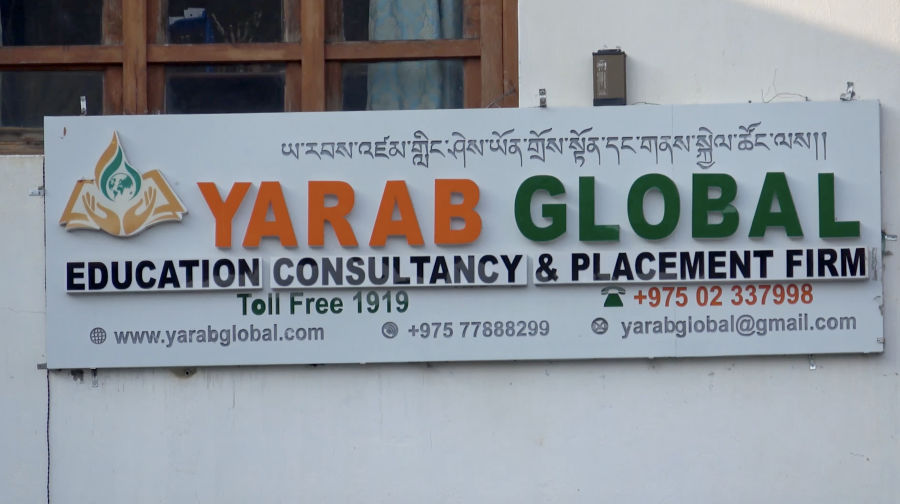
In June last year, the BQPCA indefinitely suspended Yarab Global Education Consultancy and Placement Firm following findings of forged documents and unauthorised job placements. The firm had been facilitating employment opportunities in the United Kingdom and Canada. Some clients, trusting the promise of overseas work, had even resigned from their jobs.
Regulator’s action, lingering impact
The BQPCA’s preliminary investigation found that the firm had exceeded its approved scope of operations, collaborated with unrecognised overseas agencies, issued forged documents, and continued unauthorised placements.
Although the suspension notice stated that the firm remains accountable to the clients whose applications were processed before the ban, affected individuals say no refunds or clear resolutions have followed.
For some clients, the consequences went beyond financial loss.
A group of them were sent to New Delhi for biometric submissions. However, authorities later confirmed that the visas shown to them were forged. As a result, several individuals were reportedly banned from entering Canada for up to five years.
Promises of overseas employment: From the UK to Canada
Interviews with the affected clients and a review of documents indicate that the firm allegedly operated across four batches between September 2023 and April 2025.
In each case, the firm began by processing work visa applications for the United Kingdom or Canada. Affected individuals say they were sent to New Delhi for biometric submissions, after which the firm’s Chief Executive Officer (CEO) would reportedly show what appeared to be approved visas through video calls, reinforcing the impression that their applications had succeeded.
According to one of the clients of the first batch, the recruitment was carried out through online advertisement. “There was an online advertisement for caregiver jobs in the UK, promising high salaries and visa success.” She said she registered in September 2023 after being added to a WhatsApp group titled ‘UK Registered Nurse.’
Between September 2023 and June 2024, she and seven others paid a total of Nu 1.397 M in instalments, including the consultancy fee. The firm allegedly promised them jobs as caregivers in a company called Cedar Foundation.
“We were asked to pay Nu 200,000 for the offer letter from the Foundation, which we received after the payment. Then, we were asked to pay another Nu 500,000.”
The final instalment of Nu 672,000 for the first batch was paid in June 2024. Throughout this period, the clients said that the firm assured them that the employment process was progressing smoothly.
However, the firm’s CEO later informed the clients via WhatsApp that he had been scammed by his Indian counterpart. He supposedly cited issues related to Visa Facilitation Service (VFS) appointment dates as well.
According to one of the affected clients, when they sought a refund, the firm repeatedly delayed it with various explanations and, at times, shared VFS documents later found to be false. In late September, the UK program was eventually declared unsuccessful, despite earlier assurances that the process would be completed within six months.
Clients were then shifted to various Canadian work programmes under different overseas partners. They say that job offer letters were issued on October 4, 2024; however, no further documentation followed.
“Our refund requests were denied, assuring us that a more reliable arrangement was underway.”
A subsequent program was introduced, assuring departure by January 2025.
“But inconsistencies soon emerged, and our refund requests were once again denied.”
The affected clients said they were later sent to New Delhi for biometrics before submitting passports for visa processing.
The firm and the clients signed an undertaking in March for a full refund by early April 2025.
“In April, we were told that our files had been transferred to another company and through a video call, they showed us what appeared to be a visa sticker. We then requested for our passports to be returned to Bhutan, but the CEO said that they might get lost in transportation. He assured us to return them in Delhi before our departure.”
However, on May 12, 2025, the Canadian High Commission in New Delhi confirmed that the visas were forged.
Second, third, and fourth batches
The second batch faced a similar experience after applying for farming jobs in Canada, with clients collectively paying over Nu 7.5 M.
For the third batch, individuals applying for caregiver jobs in Canada reportedly paid over Nu 1.4 M each.
One client detailed a series of payments made between February and April 2025.
“I paid Nu 16,000 for the VFS appointment, Nu 200,000 after biometrics, Nu 345,000 after the Passport Request, and Nu 805,000 after being shown a video of the visa stamped on our passports.”
Suspicion grew when passports were withheld, and clients were instructed to travel via Delhi instead of exiting through Paro. Two weeks later, they were informed that the CEO himself had been scammed and were shifted to a new UK group.
A 28-year-old man in the fourth batch said he paid Nu 850,000 for a farming job in Canada, only to later be told that the CEO had been scammed by two lawyers.
“He even sent videos claiming he had gone to the Delhi Police. The firm was later closed following multiple complaints, and we were shifted to a European work visa,” he adds.
Financial loss and long-term consequences
By then, the financial damage was extensive. Across different batches, clients say they paid amounts ranging from several hundred thousand Ngultrum to several million, depending on the programme.
For many, the impact did not end with a financial loss. Several affected individuals say other consultancy firms now refuse to take up their cases because of visa bans linked to forged documents.
“When we try to apply elsewhere, we have to explain that we were scammed,” says one of the affected clients. “But consultancies are reluctant to take our cases.”
Some say they were told that clarification letters would be issued to explain their situation, but no such documents have materialised.
Investigation Continues
In July last year, the BQPCA forwarded the case to the police for further investigation.
According to information shared with victims, more than 30 individuals have filed formal complaints. They said the police investigation is ongoing, with international cooperation sought to trace those involved.
BBS sought official confirmation from the police regarding the investigation’s status, but did not receive a response at the time of publication.
Waiting for accountability
For the affected clients, the closure of the firm has brought little relief.
“The consultancy is shut, but our lives are still on hold,” says one client. “We just want accountability and a way forward.”
Tashi Dekar
Edited by Sonam Wangdi