
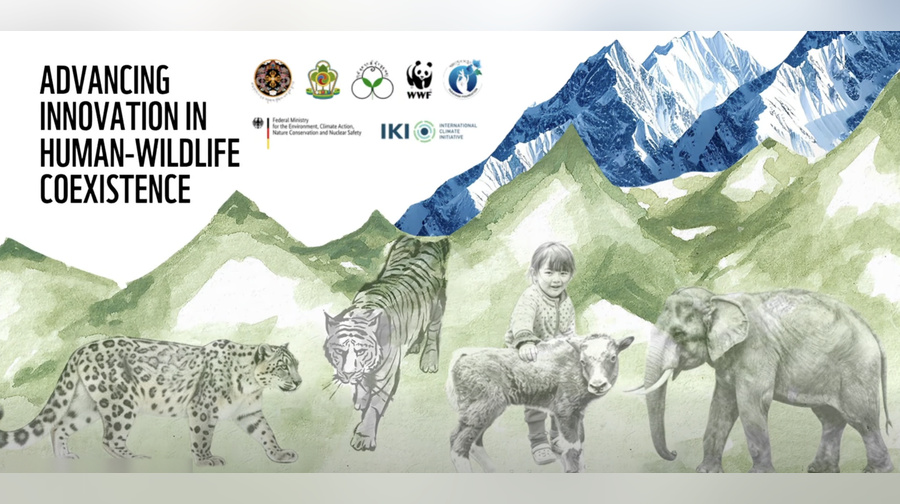
 What will it take for people and wildlife to share the same land without one paying a price for the other? Experts say quick fixes are not enough. A lasting coexistence needs sustainable financing, better development planning, and a bigger role for communities and the private sector. A regional conference in Thimphu brought these issues into focus, exploring ways to make coexistence work for both people and wildlife.
To begin with, the Department of Forests and Park Services says existing mitigation measures, including electric fencing, are not always effective for every species.
Tshering Samdrup, Deputy Chief of the Department of Forests and Park Services, said measures designed for smaller mammals may not work for larger animals, birds or species that can climb over fences.
“I would say that the funding availability is not enough or sufficient to focus on the area, other than those hotspot areas,” he said.
Funding also remains a challenge, as most of the department’s current mitigation interventions depend on donor-funded projects, with resources largely directed towards identified conflict hotspots.
The WWF-Bhutan is also working to mobilise resources for long-term conservation financing. It has committed to raising at least one billion US dollars over the next 10 years for tiger landscape conservation.
Chimi Rinzin, Country Director of WWF-Bhutan, said the organisation is exploring long-term financing mechanisms to address the limitations of relying on projects with five-year funding cycles.
“We are very aware of this five-year project duration cycle, and we are actually trying to address that by coming up with long-term financing mechanisms and solutions,” he said.
To attract private sector funding, WWF-Bhutan is proposing a Tiger Impact Certificate. Under the proposed mechanism, companies and individuals would pay for certificates, with the funds linked to measurable conservation results.
However, Chimi Rinzin said the initiative must also deliver benefits to communities living alongside wildlife.
“What we’re saying is this Tiger Impact Certificate, this outcome-based or result-based financing mechanism, has to be anchored at the local level. Otherwise, it’s not going to work. There’s no incentives for the companies, for example, private individuals, to pay for the certificate if they do not see the benefit it has on communities,” he said.
The conference also highlighted the need to consider wildlife movement when planning development activities. While Bhutan has forest and development policies, the WWF-Bhutan says coexistence is not adequately addressed in these plans.
Chimi Rinzin said the construction of farm roads without considering wildlife migration routes can affect animal movement and push tigers into areas where communities live.
The WWF-Bhutan also sees potential in nature-based tourism to create opportunities for visitors and bring benefits to communities living in wildlife areas.
Tshering Samdrup said addressing human-wildlife conflict requires cooperation beyond the Department of Forests and Park Services.
“The Human-Wildlife Conflict is a systemic issue. It’s very important for every stakeholder, every community, not only the implementing agency like the Department of Forestry; it’s very important for every stakeholder like the Department of Livestock, Department of Agriculture, and every community who bears the problem of the Human-Wildlife Conflict to come together and co-create the design to mitigate the Human-Wildlife Conflict measures,” he said.
The discussions have shaped the Bhutan Coexistence Agenda 2030, which WWF-Bhutan says will help translate existing strategies into practical measures that benefit both communities and wildlife.
The agenda is expected to provide government agencies, conservation organisations, the private sector and communities with a common platform to work towards lasting human-wildlife coexistence.
Sherub Dadron Palzom
Edited by Sonam Wangdi