
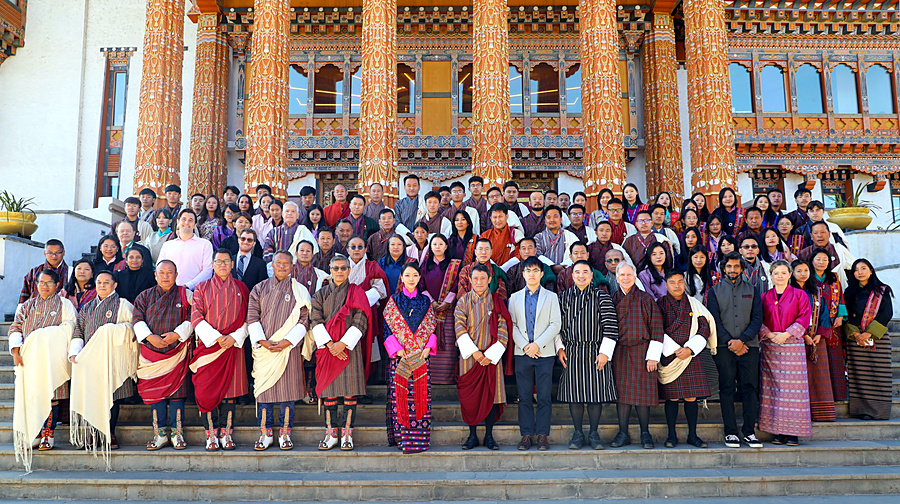
 Can small countries influence global development without relying on economic or military power? Bhutan believes ideas such as Gross National Happiness (GNH) can offer an alternative approach. This was the focus of the fifth International Conference on Gross National Happiness and Law, which opened in Paro yesterday. Her Royal Highness Princess Sonam Dechan Wangchuck graced the opening ceremony.
For decades, Bhutan has promoted GNH as an alternative way of measuring national progress. Rather than focusing only on economic growth, the philosophy places people’s wellbeing, culture and the environment at the centre of development.
At the conference, discussions highlighted how small countries can influence the world through ideas and values, rather than their size, wealth or military strength.
Sonam Tshering, Associate Professor at the Jigme Singye Wangchuck School of Law, said leadership does not necessarily depend on military or economic power, but on the ability to grow collectively while maintaining sustainability and preserving national values.
“It doesn’t necessarily mean that we have to have military might or economic power, but rather it’s about how as a human being we can grow together collectively in a sustainable manner and preserve the values of the country.”
Minister for Industry, Commerce and Employment Namgyal Dorji said small countries could exercise leadership by advancing ideas that could influence how the world thinks.
“The essence of small state leadership is the courage to advance an idea that may one day change how the world thinks.”
The discussions also examined how Bhutan could translate GNH principles into practice, particularly through the Gelephu Mindfulness City project.
International participants said the city’s approach could offer lessons for future urban development.
Sarah Moser, Associate Professor at McGill University in Canada, said Gelephu Mindfulness City was taking a different approach from many other new cities. She said its philosophy could offer valuable lessons in the next 20 to 30 years, although its success would depend on how the project unfolds.
The conference is also exploring how GNH principles can be applied to urban development, law, governance and leadership.
Organisers hope the discussions will encourage further research and prepare young Bhutanese to carry these principles into future leadership and decision-making.
Karma Samten Wangda, Paro
Edited by Sonam Pem