
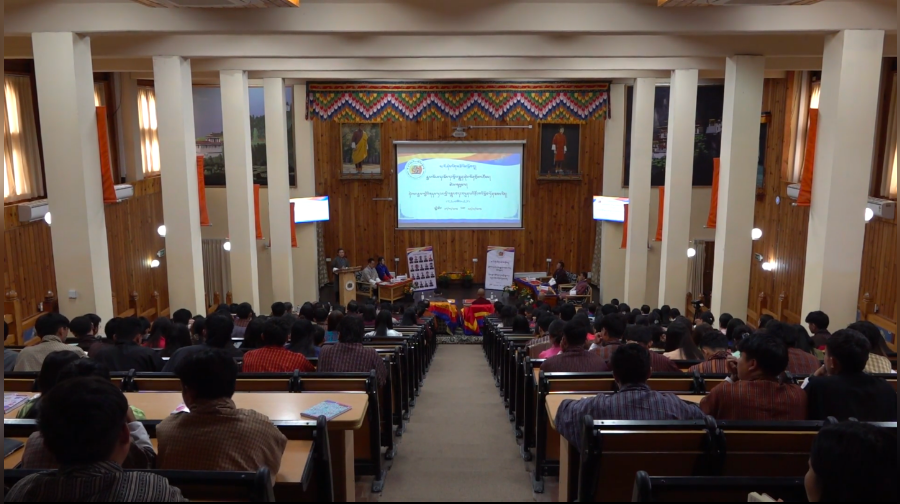
 Many Bhutanese students struggle to speak and write Dzongkha correctly, even though it is the country’s national language. Educators say the language environment at home and school, along with the way Dzongkha is taught, may be contributing to the problem. They are now looking at ways to help students use the language with greater confidence. The issue was among those discussed at a two-day National Seminar on Buddhist and Traditional Education, which concluded today at Paro College of Education.
At school, students learn to read and write Dzongkha. But for many, putting the language into practice remains a challenge. Educators say pronunciation and spelling remain major challenges. They also point to students’ limited interest in the subject.
Research presented at the seminar found that students’ language environments can influence how they pronounce Dzongkha words. Regular use of local dialects and greater exposure to English were identified as factors associated with pronunciation errors.
Samten Tharchen, Assistant Professor at Paro College of Education, said pronunciation is a major concern in schools across the country.
“Students are often influenced by the pronunciation used in their mother tongue, their surrounding environment and even their teachers. As a result, these pronunciation issues continue to persist,” he said.
The difficulties extend to writing, particularly spelling. Teachers say students often struggle to apply spelling rules consistently.
Khandu Zangmo, a teacher at Babesa Higher Secondary School in Thimphu, said, “Another major issue students face is writing, particularly spelling. Handwriting can improve with practice, but spelling is more complicated. When students do not understand spelling rules and begin using different spellings for the same word, it creates further confusion.”
Educators say improving the way Dzongkha is taught is part of addressing these difficulties. The research findings also suggest using Dzongkha across other subjects, giving students more opportunities to practise the language.
Khandu Zangmo said, “One solution is to develop an effective method for teaching spelling and pronunciation, especially how words are pronounced when their spelling does not clearly indicate their pronunciation. With a standard method that everyone can follow, backed by proper research, we can address these difficulties.”
Educators say sharing research findings and exchanging ideas can help teachers improve their methods and respond to students’ changing learning needs.
Tshering Penjor, an organiser from Paro College of Education, said, “Publishing these research papers will not only contribute to Dzongkha development but also give students and teachers practical ideas on how to teach and learn the language in a changing world.”
Student teachers at the college said the conference was useful for their preparation.
Jamyang Dorji, a student at Paro College of Education, said, “The research presented at this seminar has identified challenges in Dzongkha learning and proposed possible solutions suited to changing times. This is valuable for those of us preparing to become teachers.”
Dorji Wangmo, also a student at the college, said, “The ideas shared at this seminar will help us not only during our teacher training but also when we begin teaching Dzongkha in schools. We can apply what we have learned to improve our teaching.”
For educators, the challenge is not simply getting students to pass Dzongkha examinations. They want students to speak and write the national language confidently and use it beyond the classroom. They hope better teaching methods and a stronger language environment will help make that possible.
Karma Samten Wangda, Paro
Edited by Sangay Chezom