
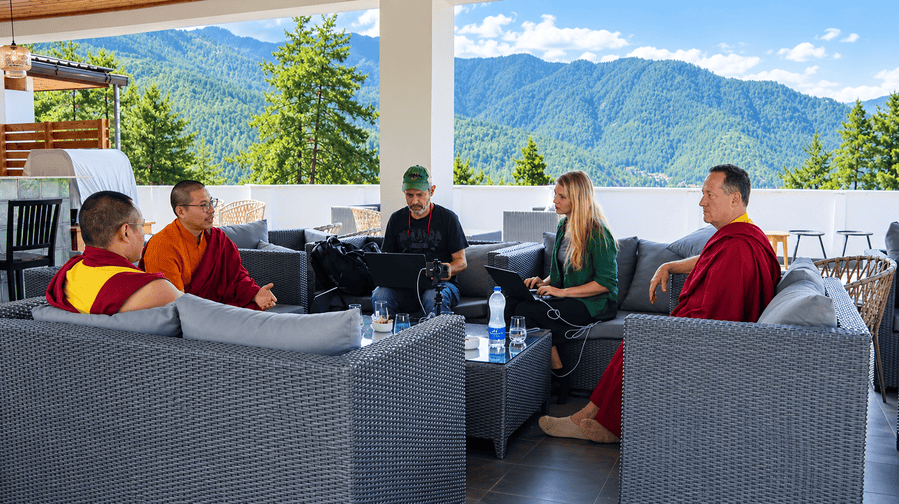
 What if you could control your dreams at night? This is exactly what a team of neuroscientists and Buddhist scholars is studying, particularly through Dream Yoga practices in Bhutan. Dream yoga is a Tibetan spiritual practice that uses the state of sleep and dreaming as a path for personal growth and spiritual awakening. By understanding dream yoga, researchers aim to understand control over dreams and the importance of sleep, combining traditional Buddhist knowledge with modern neuroscience.
During sleep, most of our body is temporarily paralysed, but our eyes and breathing muscles can still move.
Researchers used EEG recordings, which measure and record the brain’s electrical activity while the participants are sleeping.
They also communicated with participants using specific eye movements to show that the dreamers are aware they were dreaming.
This is often known as lucid dreaming.
The participants also used breathing signals, such as repeated sniffing, to show when they are practising Dream Yoga, allowing researchers to study brain activity at that exact moment.
“If they only told us when they woke up, we wouldn’t know exactly when during the night it happened, but this allows us to look at the brain activity at exactly that time, and we hope to understand the practice better. So we’re looking at a wide range of practices that these wonderful monks engage in and trying to understand them and understand how they are beneficial, how they are part of a broader set of contemplative practices, and how they’re different from many contemplative practices that are engaged when you’re awake, not when you’re asleep,” said Ken Paller (PhD), Lead Researcher/Cognitive Neuroscientist, USA.
The research also combines brain recordings with micro-phenomenology, an interview method used to help participants describe their experiences in detail.
“So we try to help people recall and describe their past experiences with precision. And we ask specific questions to help people realise things that are maybe not at the forefront of awareness. So, for instance, if you have an experience of, I don’t know, seeing a face, we might ask you, how did that face first appear? How was your attention when you were seeing that face?” questioned Ema Demsar, Postdoctoral Researcher, Australia.
“So, through the microphenomenology interview, we link that first-person experience with the third-person data, and they can- the neuroscientists or whatever, they can actually compare and understand the dream yoga better,” said Khenpo Namchak Dorje, Researcher.
This approach is to connect the brain activity of the participants during sleep with their experiences.
Researchers say the study could also contribute to a better understanding of sleep, consciousness and mental-health-related conditions.
“So for nightmares, lucid dreaming is now used for treatment of nightmare disorder. And we have a few studies in the lab where we’re using lucid dreaming and teaching some dream yoga to help people with nightmares. But I think it can be extended beyond that to people who have different mental health issues, for example. We’re trying to see if it could be helpful for anxiety, eventually depression or other psychiatric disorders as well,” said Gabriela Torres-Plata (PhD), Research Associate/Neuroscientist, USA.
“There are different signals of the brain that we can register, and they allow us to see different states of the brain that we’re still trying to understand. So we don’t know exactly what’s happening, but we do know that there’s interesting processing of memories so that the events that you’ve experienced recently come back during sleep, and perhaps not even in a conscious way in our dreams, but we’re processing all these memories unconsciously. And so all that’s happening during sleep, and our measurements are one way to try to understand all that so we can help people that have sleep disorders so that we can perhaps help all of us to benefit more from sleep,” said Ken Paller (PhD), Lead Researcher/Cognitive Neuroscientist, USA.
The Dream Yoga research was conducted over the past two months with 20 participants, including Buddhist scholars and practitioners from Bhutan and other countries.
The team hopes the research will provide a better understanding of Dream Yoga while creating opportunities for further collaboration between Buddhist practitioners and scientists.
For Bhutan, the study offers an opportunity to document and examine traditional knowledge through a modern scientific approach.
Singye Dema & Yangjuk Pema Lhazin
Edited by Tandin Phuntsho