 Bhutan has more doctors and nurses today than it did seven years ago. But the growth has not been uniform across all health professionals. The Annual Health Bulletin 2026 shows a steady increase in some cadres, while the number of health assistants has declined in recent years.
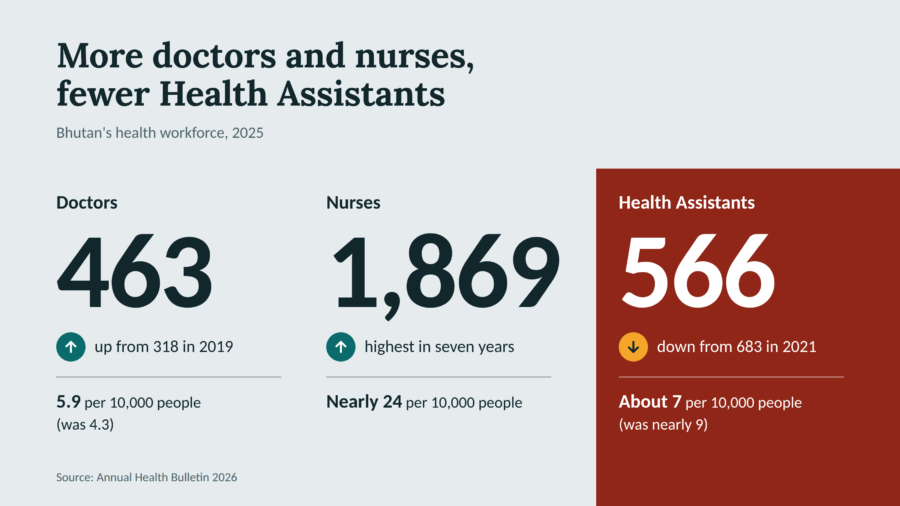
In 2019, Bhutan had 318 doctors, and the number increased to 463 in 2025. That has pushed the doctor density from 4.32 to 5.90 doctors per 10,000 people. In simple terms, that means Bhutan had about four doctors for every 10,000 people in 2019. By 2025, there were nearly six.
Despite the improvement, it remains below the global average reported by the World Health Organisation. The WHO does not set a standard doctor-to-population ratio. However, its global data puts the average density at about 16 doctors per 10,000 people, based on data from 2014 to 2021.
Nurses, the largest group among Bhutan’s health workers, have also reached their highest number in the seven years.
There were 1,869 nurses in 2025, or nearly 24 nurses for every 10,000 people.
However, the growth was not uniform across all health professions.
The number of health professionals has been declining in recent years. There were 683 Health Assistants in 2021. By 2025, that number decreased to just 566.
Their density also fell from almost nine HAs per 10,000 people to just around seven. Their changing workforce composition is particularly important because HAs play an important role in providing basic health services, especially at the primary and community level.
Traditional medicine has also seen growth, although the numbers have fluctuated over the years. As of 2025, Bhutan had 73 Drungtshos and 166 Sowa Menpas. This translates to about one Drungtsho and two Sowa Menpas for every 10,000 people.
Meanwhile, there are 62 hospitals, including IMTRAT and military hospitals, in the country.
There are 189 Primary Health Centres, including five Thromde Health Centres in Thimphu and one in Phuentshogling.
Likewise, there are 470 outreach clinics, 70 operating without sheds, that play a crucial role in providing healthcare access in remote areas.
While Bhutan has more doctors and nurses than it did seven years ago, the growth is not uniform. The numbers raise a broader question. Is the changing composition of the workforce keeping pace with the country’s healthcare needs, especially at the primary and community level?
Devika Pradhan
Edited by Sonam Pem