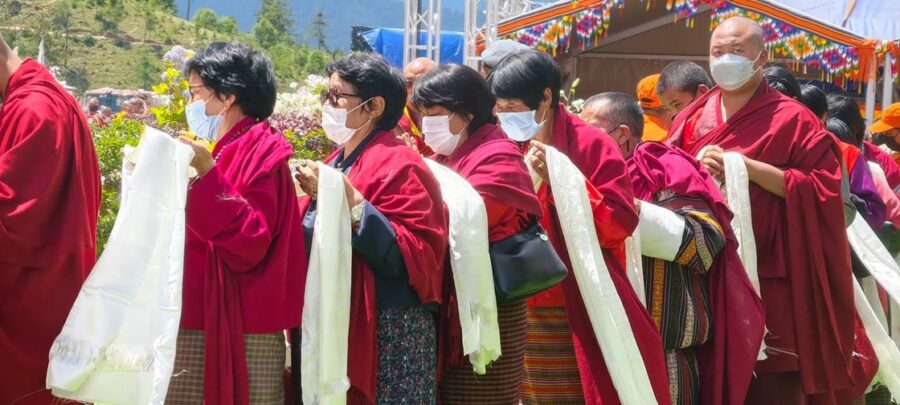
 Some of the strongest bonds in Bhutan are forged not by blood, but by faith. During the month-long Kathrid Empowerment at Kuenselphodrang, thousands of devotees are not only receiving sacred teachings from His Holiness the Je Khenpo, but they are also leaving with new brothers and sisters for life. Through a tradition that has endured for centuries, they are becoming Dorji Puen, or Vajra Siblings.
For these groups of devotees, receiving a khadar from His Holiness the Je Khenpo signifies more than a religious ceremony. It marks the moment a bond is sealed for life and, as they believe, for lives to come.
According to the Central Monastic Body, over 1,800 groups have registered to form a lifelong spiritual relationship. Each day, His Holiness confers khadar to more than 600 groups of seven.
Formed during Buddhist teachings and empowerments, the bond unites people who receive the same spiritual transmission under a common guru, committing them to a lifetime of mutual respect, support, and spiritual companionship.
“I felt immense joy when I formed my Dorji Puen. Beyond being my spiritual siblings in this lifetime, I believe they will also be my siblings in the next. If they are older than me, I regard them as my elder brothers and sisters; if they are younger, I consider them my younger brothers and sisters. Having received the khadar from His Holiness, we feel deeply blessed,” said Tenzin Namgay, a devotee from Paro.
“Through the merits accumulated in our past lives, we have the opportunity to meet as Dorji Puens. If we cherish and remain devoted to this sacred relationship, as instructed by His Holiness, we may not only be Dorji Puens in this lifetime but also be reborn as true siblings in future lives. Having such an opportunity fills us with great joy,” said Kuenzang Choden, a devotee from Thimphu.
So what turns thousands of individual devotees into families of faith? Religious scholars explained that disciples receiving teachings or empowerments from the same guru become spiritual siblings, sharing a sacred spiritual lineage that extends beyond the family they were born into.
“During an empowerment, everyone becomes Dorji Puen. However, during the Khathrid Empowerment, the tradition is an indispensable part of the ceremony. Dorji Puens are organised into groups of seven, reflecting the auspicious symbolism of the number seven in Buddhist teachings,” said Tashi Tshering, Chhukha Lam Neten, Central Monastic Body.
The ceremony serves as a reminder that spiritual progress is nurtured not only through personal practice but also through compassion, harmony, and shared responsibility among fellow practitioners.
“The tea offering ceremony continues to be observed today, much as it was in the past. However, guided by His Holiness’s vision, wisdom, and the country’s development, the ceremony has been simplified. Although it is a religious event, there is a possibility that devotees may indulge in eating meat and drinking alcohol while celebrating, thereby mixing worldly practices with religious observances. Therefore, His Holiness directed that a simple tea-sharing session with light refreshments would be sufficient to preserve the tradition while also promoting vegetarianism,” said Tashi Tshering, Chhukha Lam Neten, Central Monastic Body.
For the newly formed Dorji Puen, the scarf is not an ending but a beginning, the first step to a lifelong spiritual journey founded on faith, compassion, and mutual responsibility.
Family, often told, is something we are born into. But here at Kuenselphodrang, thousands are discovering it can also be something blessed into. As the empowerment continues, so does one of Bhutan’s most enduring expressions of spiritual kinship, proof that the strongest ties need not necessarily begin at birth.
Kelzang Chhophyel
Edited by Sonam Wangdi