
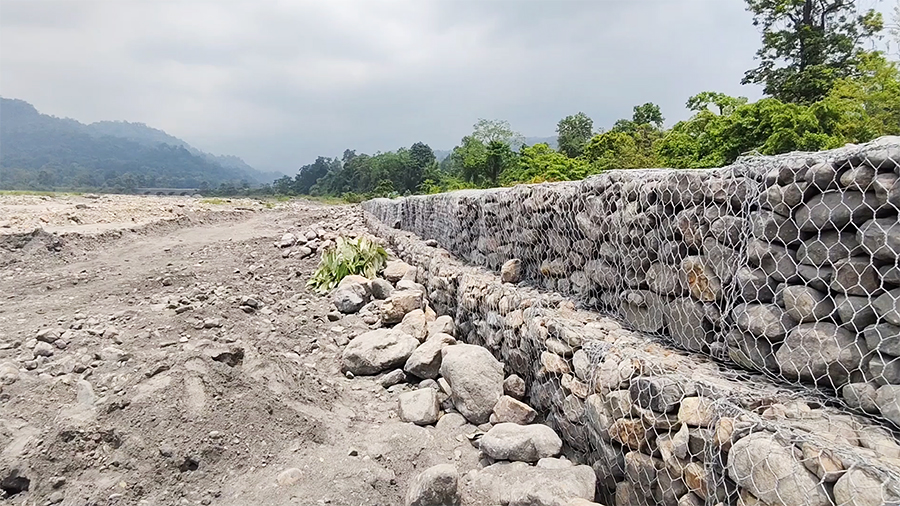
 After years of living under the constant threat of floods and riverbank erosion, residents of Ngangtshothang Toed in Tashithang Gewog, Samdrup Jongkhar, finally have some protection. A newly constructed flood protection wall along the Samrang River is expected to reduce the immediate risk to homes and farmland. But while residents welcome the project, many wonder whether it will stand up to future monsoon floods.
Every monsoon, the Samrang River swells into a fast-flowing torrent, carrying boulders and debris that eat away at the riverbank and threaten nearby homes and farmland.
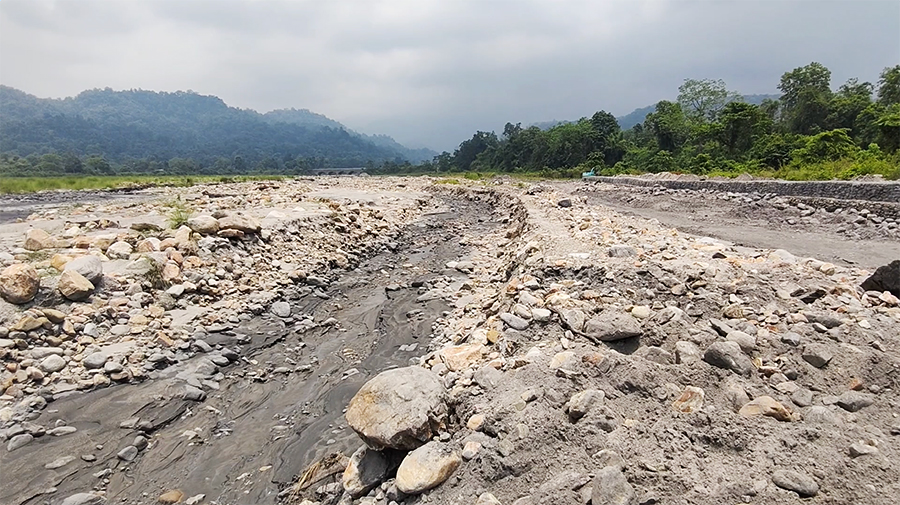 For years, residents of Ngangtshothang Toed have watched the river inch closer to their village. This year, a new gabion flood protection wall offers them a sense of relief.
“Earlier, the river used to flow further away from our settlement. But over the years, its course has shifted towards the lower side where our homes are located. We now hope this river protection wall will protect us from flooding this year,” said Lakmon Rai, a resident.
“I believe it will protect us. Without this river protection wall, the river would eventually have reached our houses and swept them away,” said Birkha Bahadhur Subba, another resident.
“Now, with this, I think water will not come here. It will benefit us; we are hoping for the best from it,” said Dipa Maya Rai, also a resident.
But that relief comes with caution. Residents say similar gabion walls built in the past were damaged by strong currents within a few years.
They say the new wall should help reduce the immediate risk, but they are uncertain whether it can provide lasting protection against the powerful Samrang River.
Lakmon Rai said, “I don’t think this will provide a permanent solution. In my opinion, it may last only about two years. Once the river water starts flowing underneath the gabion wall, it weakens the foundation and eventually damages the structure.”
Birkha Bahadhur Subba said, “I don’t think this will protect us in the long term. A concrete retaining wall would last much longer than a gabion wall. During the monsoon, mud and boulders accumulate here, causing the river to rise and flow over the gabion wall, which reduces its effectiveness.”
The Gewog Administration, however, says the wall has been designed to last for more than five years and will reduce erosion and flood risks.
Officials acknowledge that a concrete retaining wall would provide a more permanent solution, but say such a project requires funding beyond the Gewog’s current budget.
For now, they say the Nu 5 M gabion wall is the most practical and affordable option to protect the community.
Kinley Wangchuk, Samdrup Jongkhar
Edited by Sangay Chezom