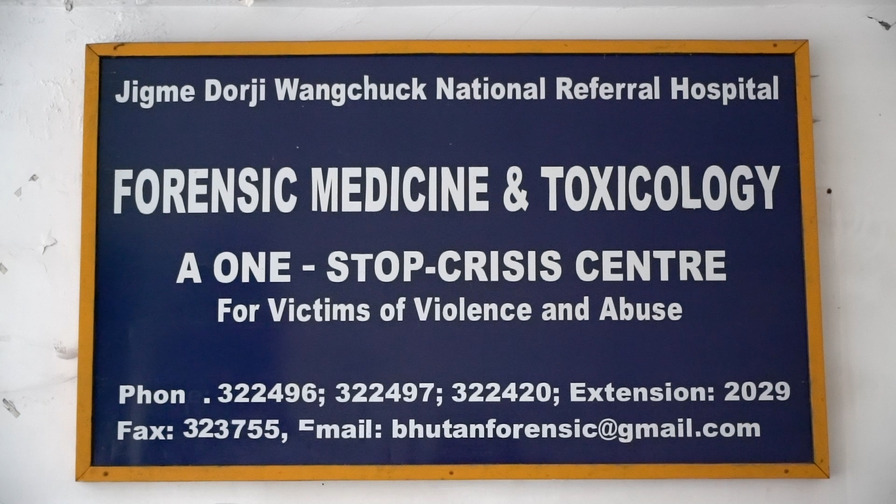
 More than 700 cases in five months. That’s the number of violence and abuse cases handled by the One Stop Crisis Centre at the Jigme Dorji Wangchuck National Referral Hospital between January and May this year. Since 2016, the centre has provided survivors with medical care, legal assistance, protection and psychosocial support under one roof, reducing the need to visit multiple agencies.
The Child Care and Protection Act of Bhutan 2011, and the Domestic Violence Prevention Act of Bhutan 2013 mandate the Ministry of Health to establish a One Stop Crisis Centre.
In line with this provision, the One Stop Crisis Centre was established at the Jigme Dorji Wangchuck National Referral Hospital in 2016.
“One Stop Crisis Centre is an integrated and comprehensive service centre that is established in the Department of Forensic Medicine and Toxicology in JD. The support services that we provide are to the victims of violence, the survivors of violence, be it physical, sexual or emotional, as well as to the child abuse survivors and neglect,” said Gyan Gurung, Forensic Medical Specialist, JDWNRH.
Over the past five years, the centre has handled nearly 8,000 cases. The highest number of cases was recorded last year, with over 1,900 cases.
“The most common forms of violence are interpersonal violence, meaning that any form of physical force that’s being used against another person, that is one of the most common forms of violence we receive, and closely followed by the case of domestic violence, particularly the intimate partner violence, and sexual violence, child abuse, and child neglect,” added Gyan Gurung, Forensic Medical Specialist, JDWNRH.
He added that the rising number of cases is placing pressure on available human resources.
The centre follows a survivor-centred approach, ensuring that the safety, dignity and confidentiality remain at the heart of all services.
Adult survivors can also choose to access medical services without pursuing legal action.
“There are certain situations in which maintaining confidentiality will be challenging, especially when legally we are supposed to report. There are certain cases where we are mandated to report. Other than that, I need to report. Otherwise, as far as possible, we ensure that whatever information is shared will be based on the consent that the survivor provides,” said Gyan Gurung, Forensic Medical Specialist, JDWNRH.
Meanwhile, RENEW, a non-profit organisation, says One Stop Crisis Centre has made it much easier for survivors, particularly in serious cases such as rape and severe domestic violence, to access the support.
The centre will soon move to a more private and accessible location when the new Multi- disciplinary Super Speciality Hospital becomes operational.
For now, the service is only in Thimphu. However, there are plans to extend the service to regional referral hospitals in the east, south and central regions.
Sonam Yuden
Edited by Sonam Pem