
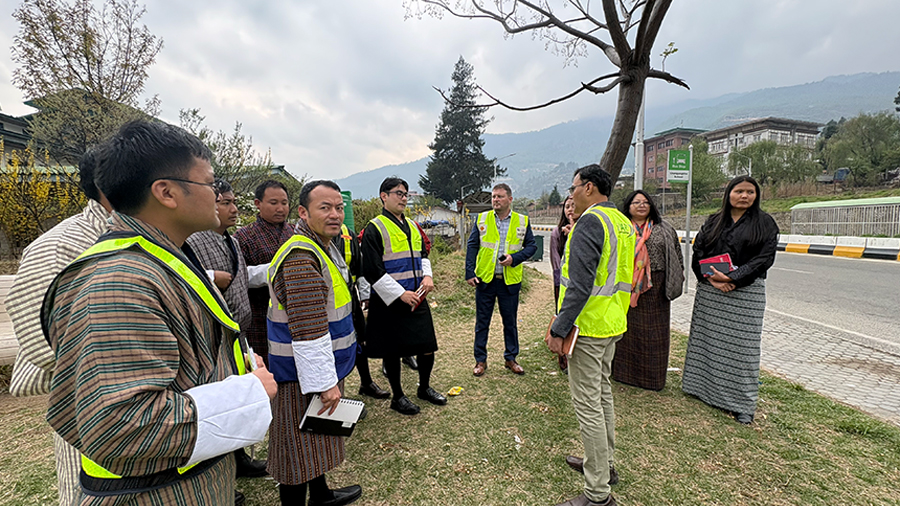
 Many drivers in the country could be driving along some of the most dangerous roads without even realising the risks. The country currently lacks the expertise to properly assess road safety, but that could soon change. Through the International Road Assessment Programme (iRAP), efforts are underway to build local capacity to identify and improve road safety. iRAP is a registered UK-based charity dedicated to saving lives by eliminating high-risk roads throughout the world.
Did you know that a decade ago, several sections of the East-West Highway were identified as high-risk?
This was found during an assessment by the iRAP in 2012 along the 1,300 kilometres of the East-West Highway.
The results showed most sections fell under one-to-two-star rating.
iRAP’s star ratings reflect the level of risk faced by individual road users on a given road.
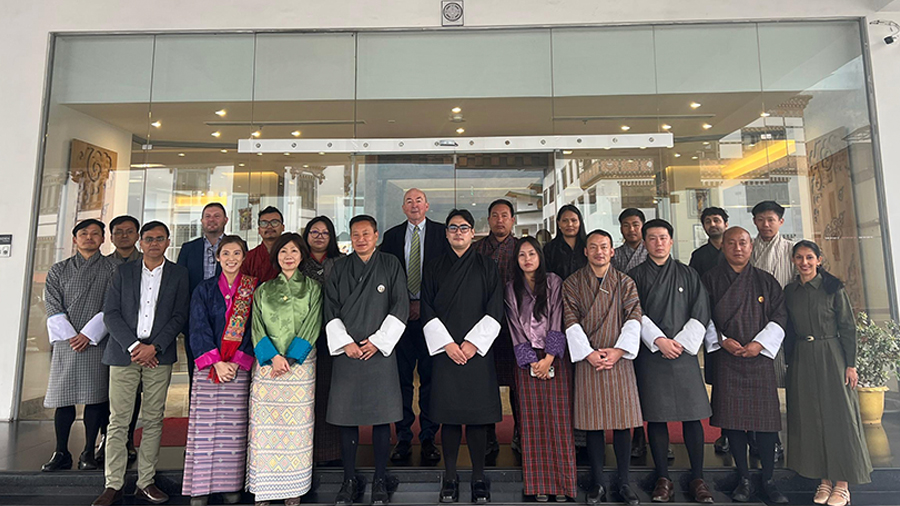 This year, as part of efforts to promote safer road infrastructure and practices in Bhutan, the Asian Development Bank held a three-day workshop focusing on iRAP and road engineering in Thimphu.
As part of this workshop, a section of the road between Dochula and Hongtsho in Thimphu was assessed. The results which will tell if the assessed road is identified as safe or high-risk will be out later.
Luke Rogers, Senior Road Safety Engineer, iRAP said, ‘‘We work with governments and road designers around the world to make roads safe. We do this through risk assessment called STAR Ratings, where we can assess roads and identify high-risk sections and recommend solutions to make our roads safer for everybody.’’
Through the workshop, participating agencies intend to strengthen safe road practices and build national expertise in road safety engineering, paving the way for a national iRAP accreditation.
Ugyen Lhamo, an assistant engineer from Thimphu Thromde said, ‘‘The road safety issue was there for a long time. We do not have expertise in road safety. I am a civil engineer, and do not have expertise in road safety. I have been working based on the past knowledge I acquired.’’
Jigme Thinley who works as deputy executive engineer of DoST said, ‘‘iRAP, as a tool, we can assess how safe our roads are. if our roads are not very safe it also gives us options of what kind of treatment plants we can use and it also gives us the cost of those and we can prioritise the cost and for a country where we don’t have so much resources we have to prioritise all of those and it gives us with which treatment gives us the best benefit in the overall case.
Sin Wai Chong, a transport specialist at ADB said,‘‘Previously, we noted that governments have a strong emphasis in road connectivity, of course, on how roads should be efficiently used by cars and good deliveries. But in recent years, we also note that there is a strong vision in reducing road casualties, improving road safety in both highways and also in urban areas.’’
Priti Gautam who is a senior transport specialist for Road Safety at ADB said, ‘‘Speed is the highest risk in the severity of injury and fatalities in road safety. Managing speed and working the police, working with design, having more speed hubs, and managing speed through enforcement and through design are some of the biggest opportunities for Bhutan. Infrastructure, we found that a lot of the fatalities are happening on cliff side roads safety barriers and prioritizing if you have limited resources prioritizing the safety barriers on these cliffs is really important.”
The senior transport officer also said that a single, centralised emergency response system is essential to improve efficiency and coordination.
iRAP has star rated over 1.9 million kilometres of roads and designs across the world, helping to meet UN targets for safer infrastructure, and prevented around 860,000 deaths and serious injuries between 2016 and 2025.
With proven tools like iRAP, focus is not just on identifying high-risk roads but also on guiding smarter investments in road safety.
Sonam Yuden



