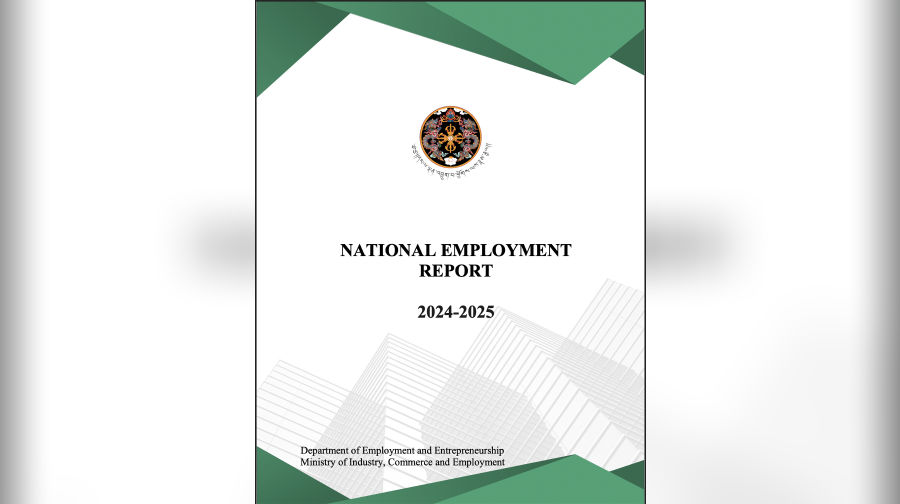
 Despite gradual improvements in overall employment, significant gender disparities continue to shape Bhutan’s labour market. While male labour force participation averaged a little over 74 per cent, only about 55 per cent of women were economically active. Similarly, unemployment for women stood at 4.3 per cent, compared to 2.5 per cent for men. This is according to the recently published National Employment Report.
The National Employment Report 2024-2025 highlights that the disparity is not due to a lack of desire to work, as evidenced by the high number of female job registrations at over 5,900, but rather barriers such as critical structural gaps, urban saturation, and a mismatch between skills supply and market demand.
The report reveals that employment opportunities for women remain concentrated in a narrow range of sectors, such as accommodation, food services, and informal work, which are often more vulnerable to job insecurity.
The report reveals that men continue to dominate technical and higher-paying sectors such as construction, manufacturing, and infrastructure, while women remain underrepresented in these fields. In manufacturing, almost 1,400 males were placed compared to 575 females, whereas in construction, 216 males were placed versus 72 females.
Similarly, under youth unemployment, the female unemployment rate remains significantly higher than that of males in the 15-19 age group, with almost 31 per cent of young women unemployed compared to around 7 per cent of young men.
Overall, the average youth unemployment rate in 2024-2025 was around 17 per cent, with females significantly affected compared to males.
While similar findings were also mentioned in the Gender Inequality in Bhutan’s Private Sector report and the Industry Census 2024, the new report says, calls for adaptive policy responses.
It mentions that the Department of Employment and Entrepreneurship will launch the Comprehensive Job Plan (2025–2029), focusing on three priorities: aligning skills with high-growth sectors, promoting inclusive opportunities for youth and women, and enhancing labour market connectivity through private-sector engagement and improved data tracking.
Tashi Dekar
Edited by Kipchu