Nearly three months after part of Changyul Bum Galem’s ancestral house in Guma, Punakha, collapsed, the owners say they have heard nothing about when restoration will begin. Meanwhile, their neighbour fears the wooden posts propping up the remaining structure could damage her own home.
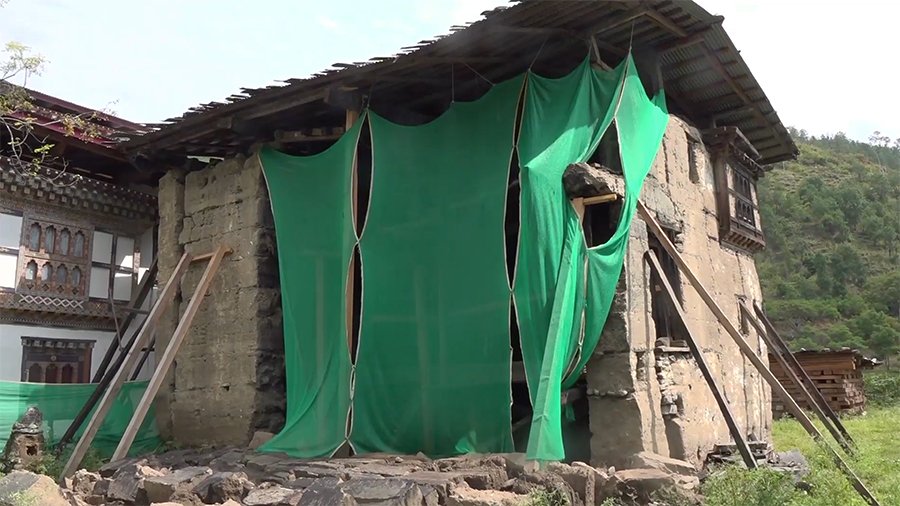 About one-third of the three-storeyed house collapsed at the rear in August. Rubble from the walls lies scattered on the ground, and large holes weaken the walls that still stand. Wooden shoring posts now hold up what remains, and green nets cover parts of the damaged building.
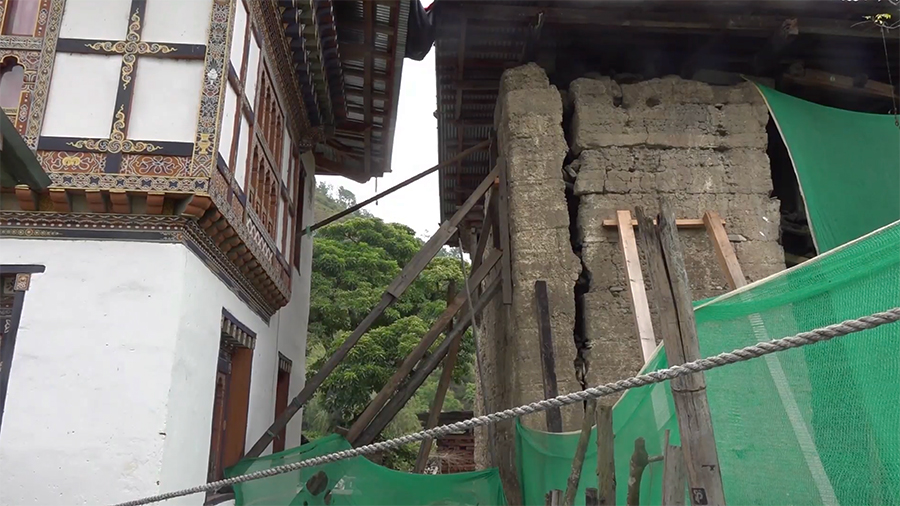 Some of the posts extend towards the neighbouring house, raising concerns about the safety of that property.
The neighbouring house belongs to Chhimi Dem, the younger sister of the owner. She says several posts lean against her house, and rainwater runs along them towards her walls during heavy rain. She fears the supports could damage her home if the old structure collapses further.
“Several wooden shoring posts have been placed against our wall to support the other structure. We cannot even sleep peacefully at night because we are constantly afraid that the house might collapse,” said Chhimi Dem, a resident of Changyul-Lungsigang-Tashijong Chiwog.
“Whenever it rains heavily or there is an earthquake, we usually leave our house and spend the night at someone else’s home. These wooden shoring posts are taking support from our wall and putting additional pressure on our house. If our house is damaged or collapses because of these poles, the government should be held responsible,” she said.
For the owner, Namgay Zam, watching the ancestral house deteriorate has been painful. The family says it wanted to rebuild the house itself, but the Department of Culture and Dzongkha Development took responsibility for its restoration some five years ago.
“The Dzongkhag Administration has kept postponing the work. They know how many years have passed since they signed the agreement and took over the house from us. Whenever we approach them, they keep citing budget constraints,” Namgay Zam said.
“If they are unable to carry out the work, they should have given us permission to do it ourselves. Our children have even made plans to take up the work. We would like to request the Dzongkhag Administration to expedite the work, whether it is to renovate the house or demolish it completely,” she added.
The prolonged uncertainty has also taken an emotional toll on the family.
“Living with the house in this condition has caused us a lot of stress. My husband has passed away, and I am still having health problems. My sister is also unwell and has been performing rituals at home because of her condition. We feel these problems may be linked to the poor condition of the old house. We never had such problems before,” said Chhimi Dem.
The owners say the history of Changyul Bum Galem has survived through generations as a story. But they fear that even this story could eventually disappear if the remaining structure is allowed to collapse completely.
The delay is not new. In June, the Department of Culture told BBS that Pro Bhutan Germany had committed 130,000 euros for the restoration. It said the project stalled because the donor’s financial year closed in December and its funding criteria then changed.
Following the partial collapse in August, the District Administration says it immediately informed the department. It says officials visited the site, put reinforcement measures in place and continue to monitor the structure while reporting updates to the Culture Department.
Changa Dorji
Edited by Sangay Chezom