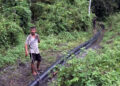
 Some trails are built. Others are worn into the hillside by generations of feet. In Monggar, 48 Scout leaders, all of them teachers, walked one of the second kind on Friday. Their aim was to give an old route a new life, as a place for Bhutanese and international visitors to discover.
A prayer before the first step. For protection and safe passage.

Then the mountain fell away. From Latongla, at 2,721 meters , the Scout leaders began a descent of more than 2,000 meters, towards the ruins of Zhongar Dzong at Menchugang.
This is a path with a past. Long before it had a name among birdwatchers, it had a purpose for the people who lived here.

“My great-grandfather said people carried rations as tax from Zhongar to Jakar, in Bumthang. They came through this stretch and crossed Phrumshingla pass. So today I am excited to walk in the footsteps of my ancestors,” said Ugyen Sonam, a teacher in Monggar.
The old route is now a thread in the Trans Bhutan Trail, more than 400 kilometres from Haa in the west to Trashigang in the east. Besides, it has also earned another name, the Birding Trail. A survey counted more than 300 species of birds here.
“Many bird species can be found along this stretch. Birdwatchers are welcome to come and explore. The trail is well maintained by the Trans Bhutan Trail. We are proud to have completed it alongside our Annual Scout Conference. We hope our campaign will reach many people and promote ecotourism in the region,” said Sangay Wangdi, VP, Monggar Central School.
“Nature offers many edible species, such as flowers and the roots of this plant. Yet our young people rarely explore the outdoors. If they did, it would strengthen their survival skills,” said Tenzin Chogyal, a teacher in Monggar.
As per some participants, knowing the forest is one thing. Looking after it is another.
“We have been planning this for three months. The district administration has been supportive. So far, it is going as planned. Today, we will maintain the trail and collect waste along the way. Today’s is a trial with the mentors, and we hope to organise a similar campaign with students,” said Kunzang Dendup, a teacher in Monggar.
It took more than seven hours for the group to complete the trail, testing their stamina, resilience, and perseverance.
Looking back at the experience, for one teacher, it meant standing where his great-grandfather’s generation once walked. For the rest, it was a step in sharing that history and the birds with visitors, local as well as those beyond Monggar.
Namgay Wangchuk, Monggar
Edited by Sonam Wangdi