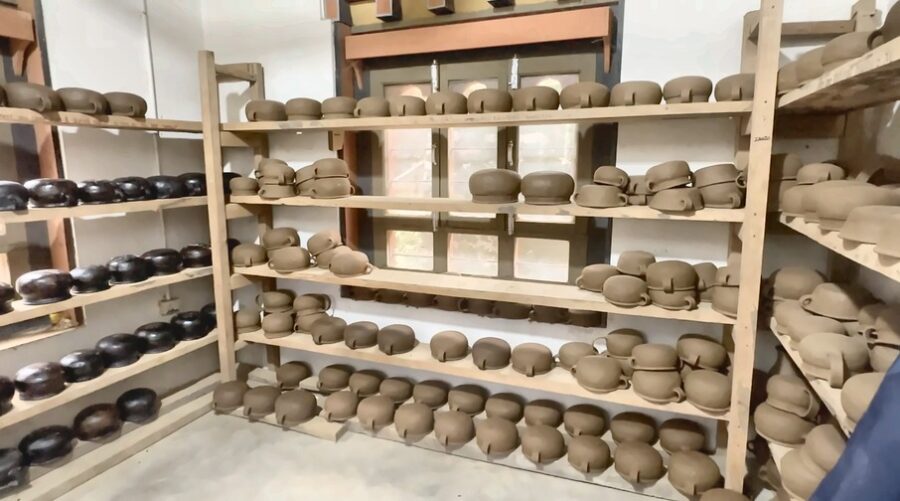
 In Gangzur, Lhuentse, an old craft is finding new customers and new makers. The Gangzur Pottery Group says demand for its handmade earthenware is growing, helped by orders from homestays, farmhouses, and customers sharing the products on social media. More villagers are also joining the work, giving the traditional craft a new economic value and a stronger chance of survival.
A year ago, Jimba Zangmo was new to pottery. Today, it is her full-time occupation and a source of financial independence. Having returned to the village after her marriage ended, the 40-year-old is rebuilding a livelihood through a craft that once had only a few practitioners in her village. She earns around Nu 30,000 a month.
“After returning to the village, I was helping my family in whatever ways I could. Later, when the government provided training on pottery to the villagers here I took part. Since then, it’s my full-time job. It does not involve hard labour toiling in the sun or rain. The returns are also better.”
Like Jimba, more people, in the village, particularly women, are taking up the traditional knowledge. From two experienced potters several years ago, there are 13 of them today. They came together and formed the Gangzur Pottery Group.
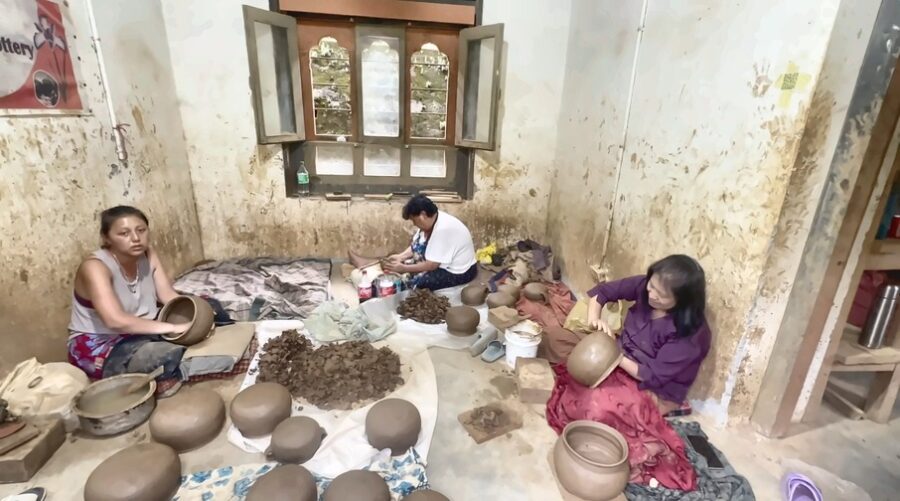
Their work begins long before a pot reaches the market. The clay is pounded and sieved, mixed with water, and beaten and kneaded on a flat stone until smooth enough to mould. The potter then shapes it by hand. The finished form must be dried before firing to turn it into a durable ceramic.
On average, each member makes more than 20 pots a day. Prices range from about Nu 200 to Nu 1,000, depending on size and design.
“Our products are mostly sold to homestays and farmhouses, especially the bigger ones. There’s no problem in selling the smaller ones either. Our products also gained popularity after some of our customers showcased them on TikTok,” said Ugyen Yangzom, a potter, Gangzur Pottery Group.
“I joined the group because we do not have much farm work to do. Pottery is a financially stable alternative because marketing the products is not an issue. In fact, we are unable to meet the demand,” said Rinchen Zangmo, another potter, Gangzur Pottery Group.
Demand, however, does not automatically mean the potters can produce more.
“One of the main challenges we face is the weather. In summer, it rains and it is difficult to properly dry our fresh pots. In winter, cracks appear on them due to the cold. However, we prefer summer because we can dry the pots inside using fans,” said Dechen Wangmo, also a potter at Gangzur Pottery Group.
Despite the challenge, for now, demand is doing what preservation efforts alone cannot always achieve: giving people an economic reason to learn and continue the craft.
Looking ahead, as the potters feel, today’s interest should be converted into reliable skills and sustainable earnings through training and equipment support from relevant agencies. They say, the future of an old craft is not just shaped by hands but by how well tradition, upskilling, and product diversification can work together.
Namgay Wangchuk, Lhuentse
Edited by Sonam Wangdi