
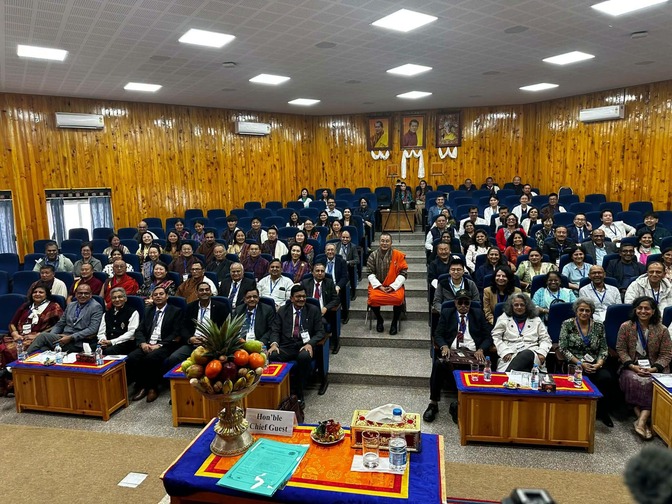
 More than 70 international experts have gathered in Thimphu to exchange knowledge on childhood eye diseases and strabismus as part of the 5th South Asian Academy of Ophthalmology, Paediatric Ophthalmology, and Strabismus Association Internal Conference. Bhutan is hosting the event for the first time, allowing Bhutanese doctors to share local expertise and, at the same time, learn from international experiences.
With international experts from around 15 countries participating, the conference highlights critical and new eye-related issues in the medical field. It also discusses different treatments for eye-related diseases, especially strabismus.
Strabismus is a condition in which the eyes do not align properly when looking at an object. It is commonly known as crossed eyes or a squint. Experts say that although it may be seen as a cosmetic issue, strabismus can interfere with how the eyes work together. In children, timely assessment and treatment are important for healthy vision development.
As per the national health data, Bhutan recorded 1,218 cases of strabismus in 2025. The condition was most common among children aged five to nine.
According to Bhutanese doctors, the conference provides an opportunity to strengthen the diagnosis of such eye conditions and identify medical interventions that may be adapted to Bhutan’s health system.
“It’s not just about us all the time learning from other countries and other health systems. We have speakers from the country, a couple of us who will be presenting over the next few days. It’s also to showcase how we can be innovative despite our limited resources, and how we adapt to make healthcare better for all our ophthalmology patients,” said Dr Dechen Wangmo, Paediatric Ophthalmologist/Head, Department of Ophthalmology, JDWNRH.
Bhutan currently has 19 ophthalmologists in the country, of which only one is paediatric.
Health Minister Tandin Wangchuk said Bhutan faces challenges that are similar in the South Asian region, including shortages of trained specialists, unequal access between rural and urban communities, and weak referral systems.
“Our mountainous terrain and scattered settlements make delivering specialised care, including Paediatric Ophthalmology, a continuing challenge. Challenges that call for partnership, innovation and shared learning, which is exactly what SAO POSA has fostered since its establishment in 2019,” said Tandin Wangchuk, Health Minister.
As such, regional conferences of this kind foster better cooperation, allowing countries to share expertise and learn from health systems facing comparable conditions.
The four-day conference will conclude tomorrow, with a closed-door internal discussion among the participants.
The Khesar Gyalpo University of Medical Sciences of Bhutan, in collaboration with the Department of Ophthalmology of the National Referral Hospital, is facilitating the event.
Singye Dema
Edited by Sonam Wangdi