
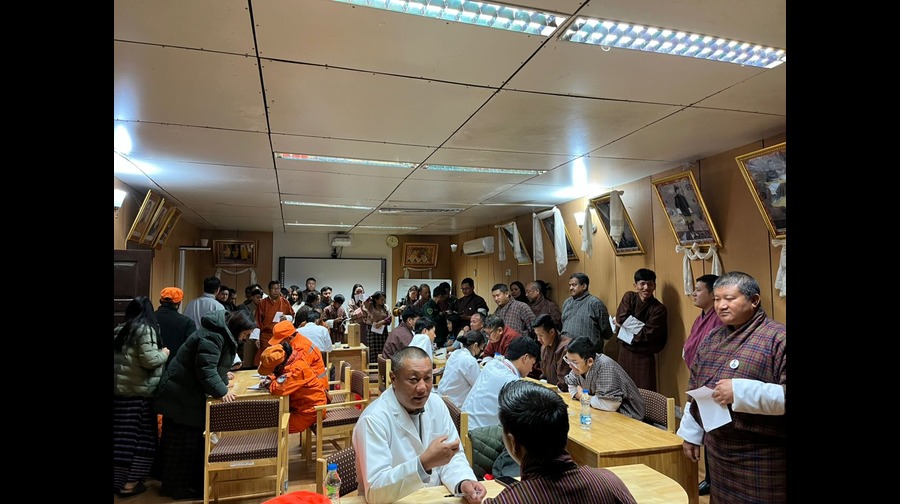
As part of the health ministry’s effort to combat the rising burden of non-communicable disease, the National Non-Communicable Disease Screening Programme commenced today in the capital. Screenings are also being carried out in Tsirang, Chhukha, Phuentshogling and Samtse and will continue until the second week of March.
During the screening, health workers check Body Mass Index, blood sugar, cholesterol and blood pressure.
Non-communicable diseases are often linked to lifestyle factors such as poor diet, lack of physical activity, smoking, and excessive alcohol use.
This time, during the screening, health officials are using a new mobile app, Bhutan Care App where individuals can access their own health information. In the past, the health ministry used paper-based forms and Google Excel sheets to record details.
Bhutan Care App is currently available on android devices.
Tshewang Lhaden, the programme officer from the Department of Public Health said, “This will help us in getting the accurate data and then it will also help us in patient care, such as following up with the patient regularly and referring the patients who require care to health facilities.”
The Bhutan Care App was developed under the Four-Bank Project, launched in 2023 to strengthen health data systems and accelerate digitalisation of Bhutan’s healthcare sector.
The Four-Bank Project will contain information about individuals related to health, medical, genetic and household information.
Tashi Choden, Project Manager of Four Banks Project, GovTech Agency said, “So, by integrating the data from the four banks, we would like to encourage the citizens to have access to the data, not just from ePIS, which is a medical bank, but also the screening data so that they have a comprehensive view of the whole healthcare journey at an individual level. So, with this, we hope to bring behavioral change. We could also use the same app for promotional activities in terms of controlling non-communicable diseases in the country.”
Meanwhile, the Chief Representative of Japan International Cooperation Agency in Bhutan highlighted the importance of strengthening Bhutan’s health system, especially as the two countries mark 40 years of diplomatic relations.
Yoichiro Kimata, Chief Representative of JICA Bhutan Office said, “So, when it comes to the Bhutan Care app, this is the entry point for receiving the necessary information from the Bhutanese citizens concerning the health conditions. By compiling those health information, of course, the government can utilise that big data into, for example, the new medicine developments or new developments of applications. On the other hand, through that kind of app, the Bhutan government also provides the necessary information to the citizens of the necessary health management of each individual.”
With non-communicable diseases on the rise, health officials say early detection and timely intervention through such health screening remain crucial.
Devika Pradhan