
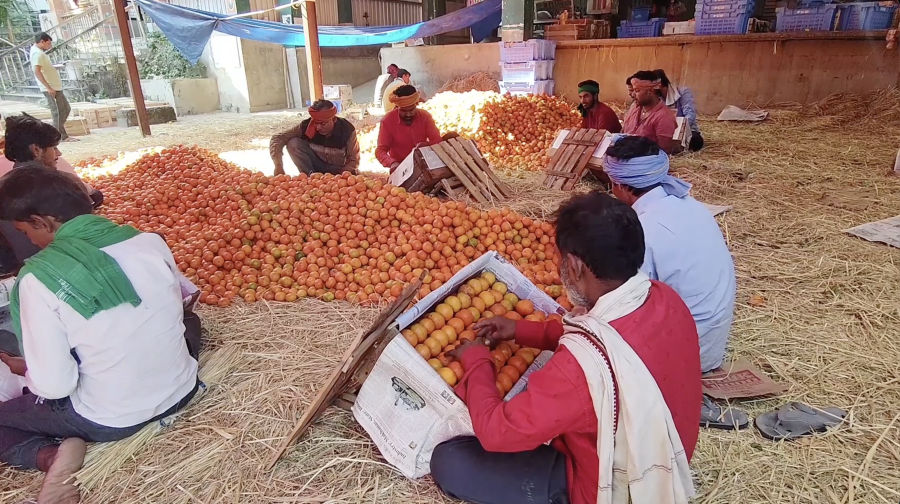
 Although the mandarin export season is underway, exporters and suppliers say the production has dropped this year in major mandarin-growing districts. Despite better prices, fewer fruits are reaching export depots due to fruit dropping, largely blamed on changing weather patterns. As a result, Samdrup Jongkhar and Tsirang, two key mandarin growing districts, are both seeing a weak season this year.
In Samdrup Jongkhar, mandarin prices are holding steady despite the low supply. A crate of larger mandarins is fetching between Nu 2,000 and 2,200, while smaller ones are selling for around Nu 1,800 per crate.
But exporters say overall mandarin production has declined this year compared to previous seasons, resulting in fewer fruits arriving at the depot.

Last year, around this time, five depots exported nearly 200 truckloads of mandarins. This year, only about 125 truckloads have been exported from six depots so far.
With the reduced supply, some exporters say they plan to close their depots by the end of this month, even though the season usually continues until mid-February.
“Compared to last year, the mandarin yield is lower this season. Although the prices are almost the same as last year, business is not expected to be as good. A significant portion of the mandarins was lost due to heavy fruit dropping,” said Dorji Duba, Exporter, Samdrup Jongkhar.
“With climate change, mandarins are now growing well in areas where they could not grow before. Prices are fluctuating, with some buyers paying Nu 2,000, while others offer Nu 1,900 or even 1,800. The price keeps changing. If we get a good price today, we may not get the same tomorrow,” said Samten, Resident, Trashigang.
A similar situation is unfolding in Tsirang. Exporters and suppliers there say mandarin yields have declined significantly this year. Initially, six suppliers were delivering mandarins to one export depot. Now, only three remain, as the others ran out of fruit due to low yield.
One exporter said he managed to export only 27 truckloads so far. Last year, during the same period, he exported 36 truckloads. With the low yield, he also plans to close the depot by the end of this month.
“Mandarin orchards that we paid between Nu 700,000 and 800,000 are unable to recover even 50 per cent of their initial cost. As a result, suppliers are facing difficult times now. When we are not able to supply mandarins equivalent to the advance we received from exporters, we have to refund the money,” said Tika Ram Pulami, Mandarin Supplier, Tsirang.
Despite the low production, prices in Tsirang are better this year. A crate of large mandarins is fetching Nu 2,200 while medium-sized mandarins are sold at Nu 1,900 per crate. Last year, prices remained between Nu 1,700 and 1,800.
According to the National Statistics Bureau’s report, Bhutan produced around 21,000 metric tonnes of mandarins last year.
Growers and exporters say that declining yields, early fruit drop and climate uncertainty are putting pressure on one of the country’s most important cash crops. Unless conditions improve, mandarin growing regions in Bhutan may see shorter seasons and lower exports in the years ahead.
Kinley Wangchuk & Pema Tshewang
Edited by Sonam Pem