
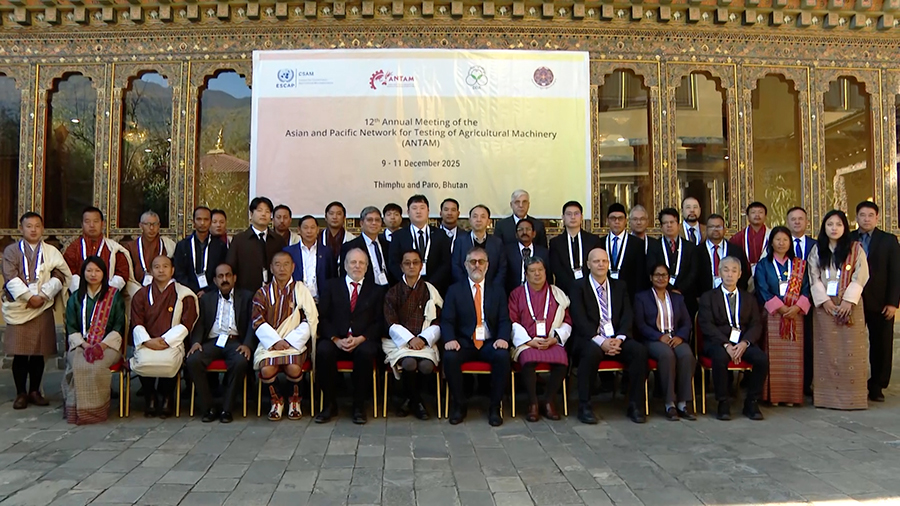
 The use of agricultural machinery has transformed traditional farming. In Bhutan, where farmers work on steep terrains and fragile ecosystems, using safe, efficient, and environmentally friendly machines is important. To support this, Bhutan is hosting a three-day annual meeting of the Asian and Pacific Network for Testing of Agricultural Machinery or ANTAM, for the first time. The meeting brings together 15 member countries to standardise testing and improve the safety and quality of farm machinery across the region.
The Asian and Pacific Network for Testing of Agricultural Machinery (ANTAM), led by the United Nations Economic and Social Commission for Asia and the Pacific, is a regional network that promotes safe, sustainable and high-quality agricultural machinery through standardised testing. Bhutan became a member of the regional network in 2019.
Adopting ANTAM testing codes ensures that farm machines are tested the same way in different countries. This makes safe, efficient and eco-friendly agricultural machinery easier to trade, more available and more affordable for farmers.
“If a manufacturer of machinery tests the machine here in Bhutan or in another testing station that participates in this, the test report is the same. It’s consistent. So, this facilitates the trade of machinery that is safe, efficient, and has with low environmental impact. If the trade is easier, this means that it becomes more available for the smallholder farmers. And if the trade is easier, it becomes also more affordable for the smallholder farmers,” said Marco Silvestri, Programme Officer/Deputy Head, Centre for Sustainable Agriculture Mechanisation, UN ESCAP.
There are more than 10 private companies in the country that import and sell farm machinery. The Agriculture Machinery and Technology Centre in Paro, staffed with five people, tests these companies’ machinery.
Bhutan has a national standard that tests over 20 types of farm machinery, but only a few have been aligned with ANTAM standards.
Officials said this meeting is an opportunity to access improved technologies and strengthen national testing capacity.
“Aligning standards is not a big task. So, it is just to adopt, it’s just to follow. And it’s just about getting the systems in place. So, in that way, I think definitely we can use ANTAM standards here in Bhutan. So, if you look at ANTAM, ANTAM is a group of countries trying to promote farm machinery and keep the farm machinery equipment in better shape or have efficient and good quality equipment for the farmers,” said Karma Tshetrim, Head of Standard Division. Bhutan Standard Bureau, MoICE.
“If I need training for certain machine testing, they give us such capacity-building training. They call us from a different country, such as Thailand. Thailand use a combine harvester, but it is not feasible in Bhutan considering our mountainous geography. However, they call us and teach us how to test. These standards and test code are something we made together. They even take our feedback,” said Pema Wangmo, Agriculture Engineer, Agriculture Machinery Technology Centre, Paro.
By aligning with global testing standards, Bhutan is paving the way for a future where quality farm machinery becomes the norm rather than the exception.
Singye Dema
Edited by Sonam Pem