
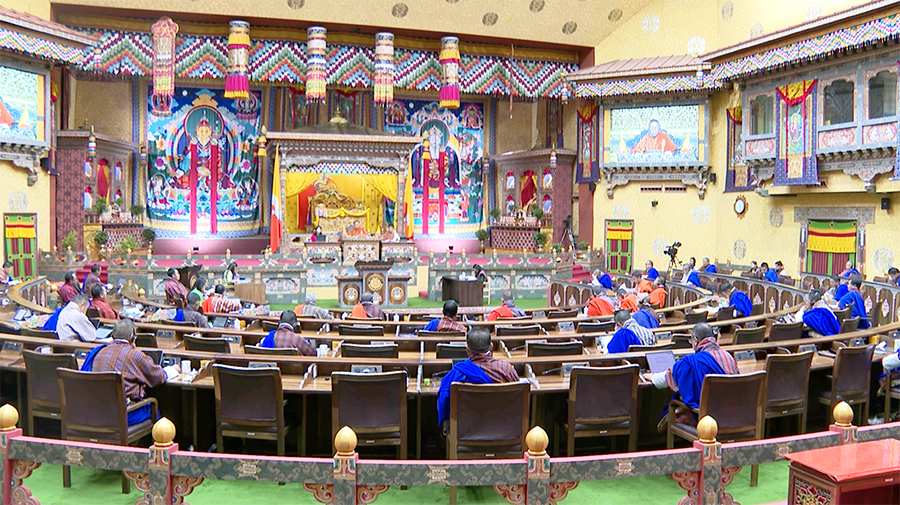
 Amid widespread public debate over the introduction of meat processing facilities, the National Assembly adopted the Livestock Bill of Bhutan 2025. The Bill, which passed with 25 votes out of 47, underwent two days of vigorous deliberation. Members also added the 10th and 25th days of every month of the Lunar calendar to the existing list of restricted meat-sale days.
Regardless of what term is used in the Bill: “abattoir” or “processing facility”, the proposal drew strong interest from members and the public.
“The committee did not present a firm idea on the meat processing unit. As mentioned earlier, while interacting with the public, the opinion was divided: some want it, and some don’t. So, we could not decide as a committee. Therefore, we put it up for the members to decide,” said Tashi Tenzin, the chairperson of the Environment and Climate Change Committee, NA.
While concerns centred on the perceived promotion of slaughter, some members clarified that proper regulation was the key objective, and not the promotion of slaughter.
“Animals will be slaughtered because people consume meat. That is why regulations are needed. This Bill does not promote slaughter; it ensures proper regulation. There is a high chance of misunderstanding, so I want to make it clear that it focuses on animal welfare in general, not on encouraging slaughter,” said Sonam Tashi, the Lamgong-Wangchang MP, Paro.
Members also debated the long-standing prohibition on selling meat during auspicious days and months.
Wamrong MP Lam Dorji said, “Yesterday, we endorsed allowing meat processing facilities. There is also a possibility that the prohibition on selling meat on auspicious days may be lifted, as the Bill does not clearly reflect it. As a member, I urge that the earlier restrictions continue.”
Energy and Natural Resources Minister Gem Tshering said, “We do not need to debate whether to consume meat or when to stock it. More importantly, we should maintain the existing exceptions for prohibiting meat sales during auspicious days and months.”
In response, the chairperson asked members to identify dates that would respect all communities’ beliefs. Today, the committee presented additional days based on these suggestions.
The current Act prohibits meat sales on the 8th, 15th, and 30th of the Lunar calendar. Restrictions are also imposed on key holy days such as the First Sermon of Lord Buddha, Descending Day of Lord Buddha, and throughout the first and fourth months of the Lunar calender.
Tashi Tenzin said, “Following yesterday’s recommendation after the deliberation, we added three days to the existing days in accordance with the 2001 Livestock Act. These are the 10th and 25th of the Bhutanese calendar and Zhabdrung Kuchhoe.”
However, the speaker pointed out that Zhabdrung Kuchhoe already falls on the 10th, resulting in the approval of only two additional days.
Meanwhile, the agriculture minister urged members to consider the long-term implications of the Bill, while the speaker reminded members that the legislation is not a new initiative.
Agriculture and Livestock Minister Younten Phuntsho said, “We had differences and had to deliberate extensively. We all agree that Bhutan is a religious country and that animal welfare must be prioritised. The Bill incorporates these principles. Hence, I would like to request all members to think about the future generations and the future of the country by supporting and passing the Bill today.”
Speaker Lungten Dorji said, “This is not a new law. It already existed. The aim is to strengthen regulations, support livestock farmers’ livelihoods, uphold animal welfare, and enhance the country’s food security.”
The Bill, which has 13 chapters, encompasses crucial chapters, such as Animal Welfare, Management and Protection, Animal Health and Production Services, Disease Prevention and Control, and Offence and Penalty.
The Bill will now be forwarded to the National Council with minor changes.
Devika Pradhan
Edited by Kipchu