
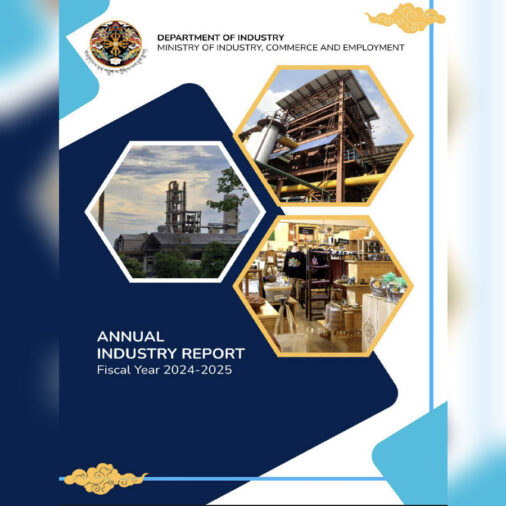
 Bhutan’s industrial sector is showing signs of recovery, driven by growth in cottage and manufacturing industries. The Department of Industry’s Annual Industry Report 2024-2025, released recently, shows a steady rise in industrial activity over the past year. The number of active industry licenses increased by nearly three per cent.
The number of active licenses increased from 29,819 in 2024 to 30,666 in 2025.
Cottage industries are driving much of this growth, rising from 9,738 licenses in 2023 to 11,154 last year.
Small-scale industries continue to dominate Bhutan’s industrial landscape. However, their numbers have decreased slightly. Medium and large-scale industries have remained stable, reflecting cautious but steady growth.
The report notes that Government support played a key role. Under the Economic Stimulus Programme, concessional loans helped boost medium and large industry approvals.
During the fiscal year, the government approved 106 new medium and large projects, an 89 per cent increase compared to the previous year, with projected investments of over Nu 22bn.
By sector, production and manufacturing also recorded steady growth. The number of active licenses increased from 3,712 in 2023 to 4,351 in 2025.
The service sector continues to be the backbone of Bhutan’s industrial landscape, representing nearly 80 per cent of all registered industries.
Meanwhile, the construction sector has experienced a gradual decline. The number of active industrial licenses fell steadily in recent years.
The report notes the rise in manufacturing as a positive indicator of diversification efforts aimed at strengthening domestic production and reducing import dependency.
Key drivers of industrial growth include financial incentives, simplified regulations, infrastructure support, and capacity-building. Programs for cottage and small industries, training initiatives, import facilitation, and 17 new FDI projects worth Nu 4.66bn contributed to this growth. Industrial estates, digital services, one-stop licensing, and fiscal incentives further eased business expansion.
However, despite the growth, challenges remain, including skill gaps, low uptake of fiscal incentives, FDI delays, non-performing industries, infrastructure risks, and concentration of activity in a few districts.
To address these, the report recommends policy reforms, streamlined licensing, easier foreign investment access, financial support, targeted entrepreneur training, market expansion for “Made and Grown in Bhutan” products, revival of non-performing industries, sector-specific Industrial Transformation Maps, and greater use of digital platforms for support services.
Bhutan’s industrial sector is broadly classified into three categories: Production and Manufacturing, Service, and Construction. Production and manufacturing involve the processing and value addition of raw materials and are further sub-classified into agro-based, forest-based, mineral-based, and others. The Service sector covers businesses such as consultancy, tourism, hospitality, automobile workshops, salons, and financial services, while the Construction sector includes firms engaged in construction and related activities.
Tashi Dekar
Edited by Sonam Pem