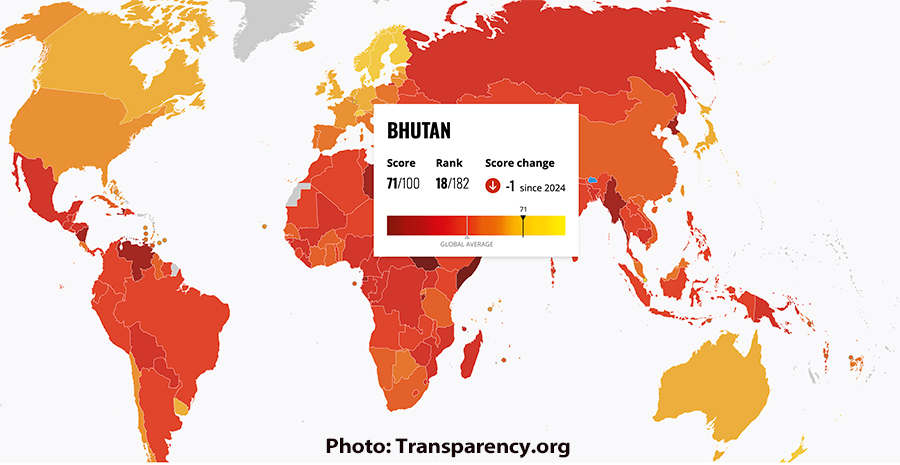
 Bhutan’s Corruption Perceptions Index, or CPI, score has dipped slightly, dropping from 72 in 2024 to 71 last year. This means that corruption was slightly more prevalent last year compared to 2024. According to the Anti-Corruption Commission (ACC), the marginal decline is mainly linked to a drop in Bhutan’s democracy-related score, rather than an increase in bribery or systemic corruption. Transparency International, the global coalition against corruption, released the Corruption Perceptions Index 2025 yesterday.
According to the report, despite the slight drop, Bhutan maintained its 18th position globally out of 182 countries and territories.
Bhutan ranked 5th in the Asia-Pacific region and 3rd in Asia.
Bhutan’s score of 71 not only exceeds the Asia-Pacific regional average of 45 but also surpasses the European Union’s average of 64, which is the least corrupt region globally.
In the South Asian context, Bhutan maintained its position as the least corrupt country in the region.
According to the report, Bhutan’s CPI performance reflects a governance system that is institutionally strong, widely trusted, and capable of enforcing accountability.
High-level corruption is uncommon, and anti-corruption systems generally work well. However, the country still faces more subtle issues in government decision-making, court processes, and large public projects. The report says that to maintain and improve the CPI, the country needs more targeted reforms that make everyday government work more predictable, transparent, and honest.
Bhutan’s CPI is based on four data sources, the Bertelsmann Transformation Index, the World Bank’s Country Policy and Institutional Assessment, the Varieties of Democracy index and the Global Insight Country Risk Ratings.
Denmark has consistently maintained its position as the most corruption-free country, followed by Finland and Singapore.
More than two-thirds of countries scored below 50.
The CPI ranks 182 countries and territories worldwide by their perceived levels of public sector corruption. The results are given on a scale of 0 to 100, with zero considered as highly corrupt and 100 as very clean.
Tashi Dekar
Edited by Phub Gyem