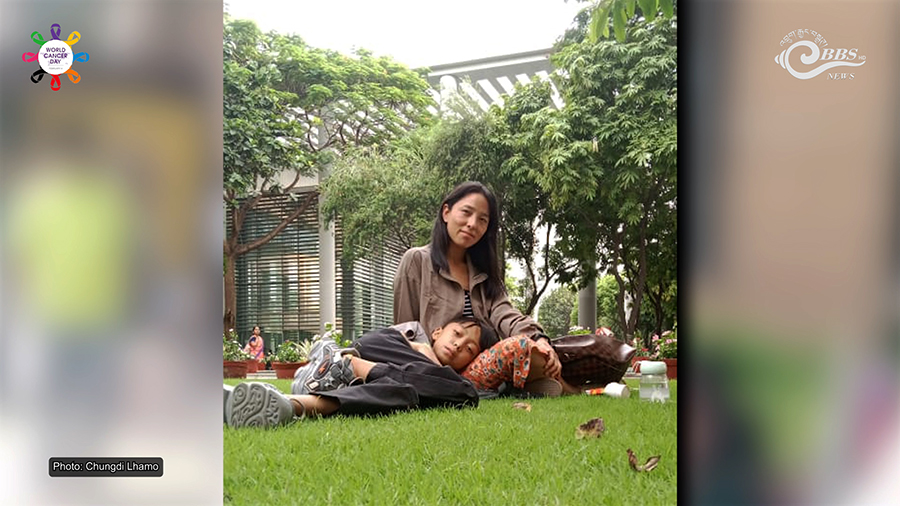
 Imagine a child who wakes up one morning with ear pain. A few hospital visits later, that same child is told that he has blood cancer. That is how life changed for a 10-year-old boy and his mother, Chungdi Lhamo, last year. As a single mother, she had to put her life on hold, leave her village in Zhemgang and move to the capital for her son’s treatment. On World Cancer Day today, we bring a story of sacrifice, resilience and unwavering love.
“The doctor first told me that my son had a thyroid problem, so I brought him to Thimphu. But the eye doctor here said it wasn’t thyroid, and we had to run blood tests. That is when we found out it was blood cancer- AML (Acute Myeloid Leukaemia), which we didn’t know initially,” said Chungdi.
Acute Myeloid Leukaemia (AML) is a fast-growing cancer that affects blood and bone marrow. It occurs when abnormal white blood cells multiply rapidly and crowd out healthy cells. In Bhutan, nine children were diagnosed with Acute Myeloid Leukaemia between 2019 and 2022, according to the National Cancer Report. The cancer was specifically identified in children aged 0-4 and 10-14. The World Health Organisation classifies it as an aggressive cancer that requires urgent diagnosis and treatment.
The news of her son’s diagnosis broke Chungdi. Cancer was something Chungdi had heard about on the internet, happening to people in other countries. She never imagined it would reach her home.
“When I heard about it for the first time, I didn’t know how to react, and the first thing I did was cry. I didn’t know who to ask or where to ask about it, as it was a disease I only heard about on the internet in other countries. When such situations fall upon you, you don’t know what to do.”
Everything else in her life stopped. Chungdi moved to the capital so her son could begin his treatment. Soon after, doctors referred his case to Kolkata for further tests and specialised care.
“The tests done in Bhutan were not enough, so we had to run tests again when we reached Koltata. That is when doctors confirmed that my son had AML. The doctors said that there was only a 60 per cent possibility of recovery, and the remaining 40 per cent depended on how my son’s body responded. I could not look at the doctor at that time. By then, my son had become so weak, and I felt we might not be able to save him.”
Chemotherapy began. Chungdi thought it would be six cycles.
“By the third cycle, my son’s hair started falling. Neither of us had seen that before. We were in an isolation room, and he asked if hair loss meant he had cancer. I told him it was just because of the injections, like other patients. He had a tough time undergoing the medication as he had become frail, and I had to convince him, promising him to order gifts online every time he went through chemotherapy, so he would agree.”
As the treatment continued, another struggle emerged: blood.
“My son needed 57 units of blood, and I even went knocking on people’s doors asking for blood. As Bhutanese, people are compassionate and willing to help, but most times they cannot because they have to save for their patients. So, it is difficult.”
The emotional strain was unbearable. Doctors told her that her son might need a bone marrow transplant, something far beyond her financial means.
“I was not able to sleep at night; I stayed awake till 2-3 AM and took quick naps during the day. Once, when my son was doing better, I fell asleep briefly. When I woke up, I could not unlock my phone, no matter how many times I tried. I even washed my face, hoping it would help, but nothing worked. I was that stressed. I had to call a nurse for help.”
During this time, she learned about the Bhutan Cancer Society and reached out for help. The Bhutan Cancer Society offered emotional support at a moment when she felt completely alone.
The final chemotherapy was the hardest. Her son was in the ICU for 24 days.
“That was the last chemo, and every time my child went inside, we were warned to be prepared for anything and if my child would come back alive. And we don’t know what to feel at that moment: I don’t know if it is fear or grief that I was experiencing.”
Today, Chungdi and her son are back in the country. The worst is over, but the fight is not finished. Her son is waiting for maintenance chemotherapy. The family must wait for another two to three years before doctors can say he is cancer-free.
“Some of my friends are still there, undergoing treatment. Our child’s condition changes often, and at times, it’s hard to accept what’s happening. We cannot cry in front of the child, so we hide in the washroom. If we fall sick, it only adds to the burden. That is why we must seek help.”
On this World Cancer Day, Chungdi’s story is a reminder that cancer is not fought by patients alone. It is carried by mothers who don’t sleep, and who keep going even when their hearts are breaking.
And the fight against cancer is not only about medicine, but it is also about love, support and the courage to hold on, one day at a time
Devika Pradhan
Edited by Sonam Pem