
 Should Bhutanese citizens expect better service delivery from public offices? The Royal Civil Service Commission’s latest data suggests the government has slightly more capacity to deliver services. According to the RCSC, the ratio of civil servants to the population has improved slightly, while the civil service workforce has also continued to grow.
The Bhutan Civil Service Statistics Report 2025 shows that the ratio of civil servants to the population has improved slightly, from one civil servant for every 26 Bhutanese in 2024 to one for every 24 people in 2025.
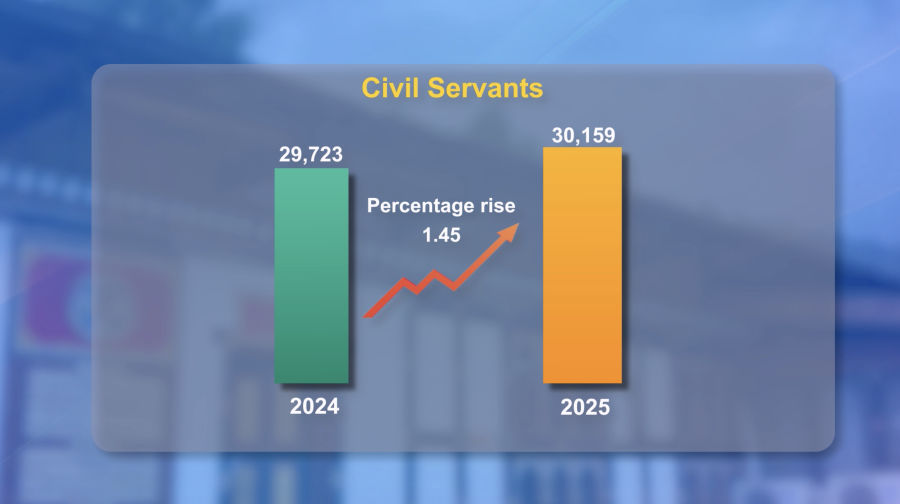
The country’s civil service workforce also continued to grow. The number of civil servants rose from about 29,723 in 2024 to 30,159 in 2025. This marked a 1.45 per cent rise.
The commission said this indicates a moderate strengthening of public service capacity relative to population growth.
2,318 new civil servants were recruited in 2025, while attrition declined slightly. After 2,013 employees left the service in 2024, separations declined slightly to 1,948 in 2025.
According to the report, all did not involve complete exits, as some reflected changes from contract to regular employment. About 1,180 resignations were also recorded as voluntary.
Meanwhile, the workforce continues to be relatively young. 70.9 per cent of civil servants are under the age of 42. The median age of civil servants remains at 36 years.
Education and Training Services sector remains the largest occupational group, employing over 36 percent of the workforce, followed by Medical and Health Services.
The RCSC says Bhutan’s civil servant-to-population ratio is reasonable. They added that their focus is not just on numbers but on improving service quality, efficiency, systems, and productivity.
Whether that translates into faster, better services for citizens, however, remains the real test.
Sangay Chozom
Edited by Yeshi Gyaltshen