
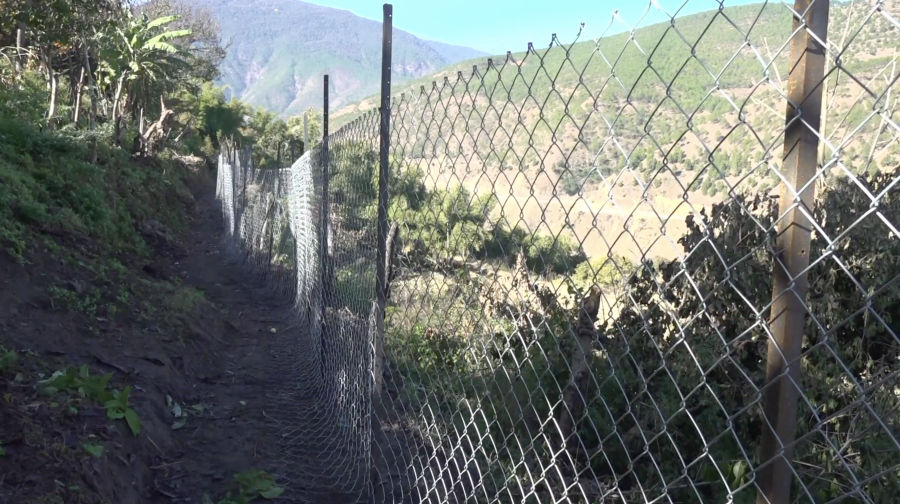
 Installing a fence to guard crops from wild animals could soon become less laborious and perhaps a little cheaper for the farmers in Wangdue Phodrang. The district administration is piloting the installation of universal hybrid fences using advanced technologies. The community-based human wildlife conflict management initiative is supported by the Japan International Cooperation Agency. If it proves successful, JICA plans to make it an effective human–wildlife conflict mitigation model and implement it for farming communities throughout the country.
Locals are finding the installation of chain-link fencing quite burdensome. They have to excavate the soil and construct walls before erecting metal poles to lay wire netting.
Farmers say the process consumes a lot of time, energy, and financial resources. They have found a better and an efficient alternative which requires very minimal effort.
Farmers of Zamding Chiwog in Ruebisa Gewog were trained for two days to install a universal hybrid fence. The pilot project in the chiwog currently covers a little over two kilometres.
For the installation of universal hybrid fence, farmers have to clear the ground, erect 250 cm metal poles, and lay 200 cm–high wire netting directly, without the need to excavate the ground or construct a wall to support the poles.
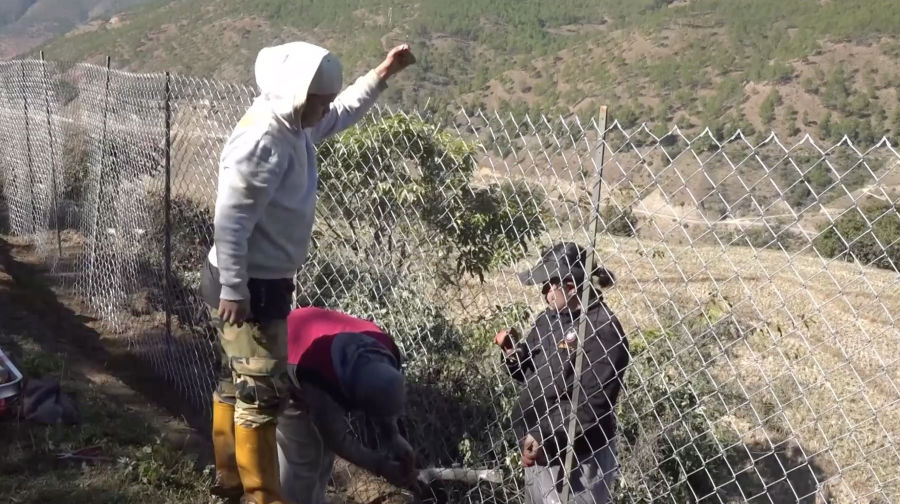
40 cm of the wire net needs to be fixed to the ground using 20–30 cm U-shaped metal pegs covered with mud to prevent entry from underneath the fence.
It is also expected to prevent monkeys from entering fields, a protection that the chain-link fence does not provide. In universal hybrid fence, farmers can lay electric wires by fixing insulators above the wire netting.
“It can deter wild boars and even monkeys, as electric wires are installed above the wire netting. This is why it will be especially effective in preventing monkeys from entering the fields. In our area, wild boars and monkeys frequently damage agricultural fields, with wild boars being the most common. Therefore, this fencing will be highly beneficial in protecting crops from wild boars,” said Yeshi Lhuendrup, Resident, Zamding, Ruebisa Gewog, Wangdue Phodrang.
“In other places, it is difficult for women to lift cement and wire netting. However, in this JICA project, it is different. The wire nets and metal poles are easily portable, even for women. We do not have to handle cement at all. They have also provided practical training on how to install this fencing,” said Tshering, Resident, Zamding, Ruebisa Gewog, Wangdue Phodrang.
“It would be extremely convenient for farmers if this project proves successful, as the work involved is minimal. We do not have to carry cement. Nowadays, there are very few young people in villages. Most residents are elderly, women, and children. The materials can be easily carried, even by women,” said Yeshi Tenzin, Resident, Zamding, Ruebisa Gewog, Wangdue Phodrang.
JICA initiated the four-year community-based human–wildlife conflict management project in May this year. It is implemented in collaboration with the National Plant Protection Centre, Agriculture Research and Development Centre Bajo and the Wangdue Phodrang District Administration.
Universal hybrid fence was developed by the Project for Community-based Human–Wildlife Conflict Management, drawing on Japan’s experience in human–wildlife conflict management and combining the advantages of both electric fencing and chain-link fencing.
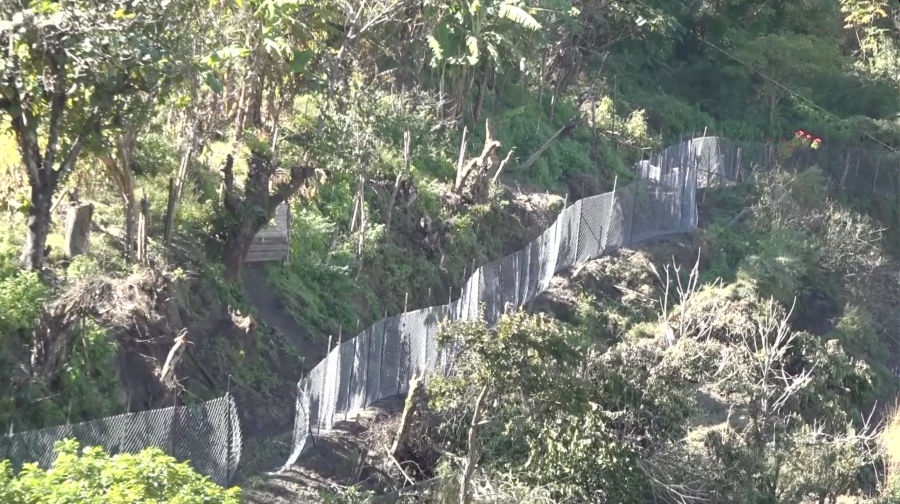
A similar project is underway in Punakha, and the same project will soon be initiated in Tsirang and Dagana.
According to project officials, this solution is well-balanced in terms of durability, functionality, and cost, and is also expected to effectively prevent almost all sorts of animals from breaking into farmlands.
Changa Dorji, Wangdue Phodrang
Edited by Phub Gyem