 As water sources continue to shrink across the country, the Natural Resources and Environment Committee has sounded the alarm in the National Council today. The committee has urged stronger measures to protect the country’s watersheds while deliberating the Review Report on Climate Resilient Watershed Management. The committee said climate change, development activities, and resource degradation are drying up water sources.
The committee said Bhutan’s watershed management lacks innovative and adaptive approaches. To address the growing issue of drying water sources, it proposed six key recommendations. One recommendation is to strengthen the Department of Water as the central agency for national water governance.
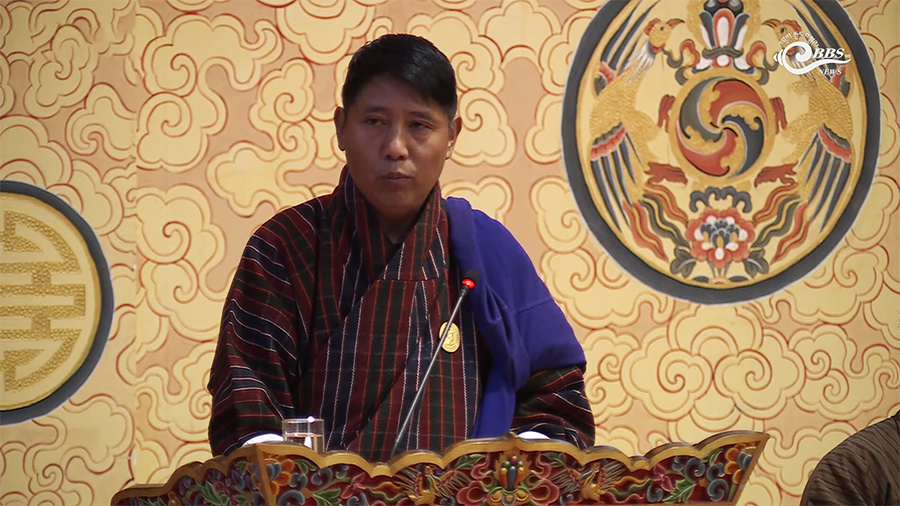
Leki Tshering, the Chairperson of Natural Resources and Environment Committee said, “Second is to prioritise degraded catchments and watershed restoration programmes. Third, establish a National Water Information System for science-based decisions. Fourth, enforce climate-resilient engineering standards.”
He added that climate-resilient designs are needed for all new intake, pipeline, and storage systems. He also highlighted the need to strengthen watershed operation and maintenance and to introduce a minimal water tariff.
Meanwhile, MPs asked about the causes of water sources that have already dried up and who is accountable for managing them.
Dago Tsheringla, National Council’s Haa MP said, “Sixty-nine water sources have dried up. What caused them to dry? Was it natural, due to resource use, or because of development activities? Knowing this will help us prepare mitigation strategies.”
Sonam Tobgyel, National Council’s Trashigang MP said, “According to the State of Climate Report 2024, Bhutan has one of the highest water resources in the world, yet each person uses only one per cent. This shows supply is not the issue. Instead of focusing only on what we have, we must understand what we are losing.”
Committee members responded that water sources are drying up for multiple reasons, and more research is needed.
Ugyen Tshering, a member of Natural Resources and Environment Committee said, “Experts say development may not be the main cause. For example, water sources in Zhemgang have dried despite limited development. Experts are studying this, and the water department is conducting investigations. But results will take time.”
Birendra Chimoria, the Deputy Chairperson of Natural Resources and Environment Committee said, “Bhutanese live in the mountains while water lies in the valleys. Tectonic plate movements shift water from one place to another, which can also cause sources to dry up.”
Bhutan has around 7,400 water sources. Each plays a crucial role in supporting livelihoods, agriculture, hydropower, and ecosystem services.
A recent assessment by the forestry department shows that more than 1,800 or more than 25 per cent of the water sources are drying up nationwide.
The house will continue deliberations on the review report tomorrow.
Singye Dema & Kelzang Chhophyel
Edited by Kipchu