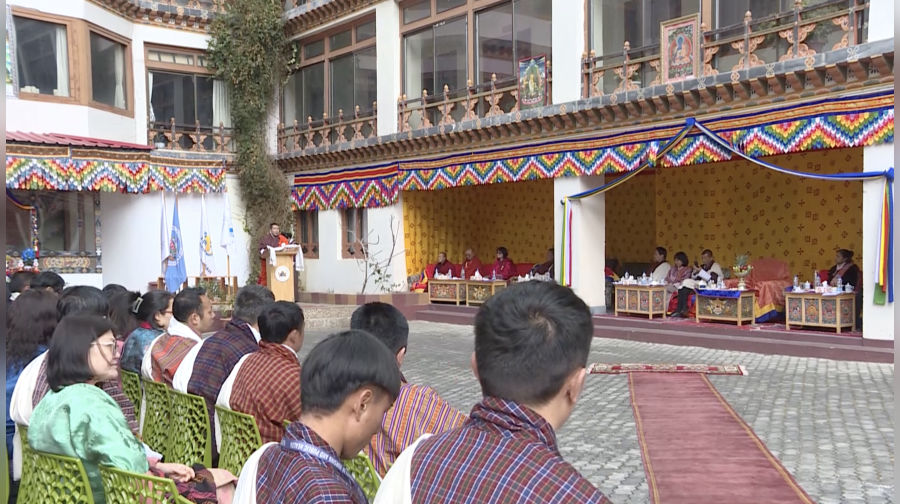
 From caring for the elderly at home to strengthening disease diagnosis, Bhutan’s first medical university is stepping up to fill critical gaps in the health system. Khesar Gyalpo University of Medical Sciences launched two new courses: a Certificate in Caregiving programme and a Bachelor in Medical Laboratory Science. The courses were launched as part of the University’s 11th foundation day today.
The first cohort will see 15 Desuups in the caregiving programme. There are plans to expand it to other interested individuals. The Certificate in Caregiving programme is a six-month course.
Kinley Gyaltshen, the course coordinator said, “So this course we have like other basic requirements needed by people who are in need, like the elderly and those who are bedridden, they can avail the care like physiotherapy and our sorig massages from a traditional medicine point of view. We have covered all these common illnesses or common medical conditions which require care at home.”
“In other countries, there are specialised groups of people who are formally trained to care for elderly individuals who are sick or require home-based assistance, and they often work in dedicated care institutions. In our country, while we may not have similar institutions, we do have comparable initiatives. For example, under His Majesty’s People’s Project, we have the Geonsho Tshamkhang, where around 60 elderly people reside. As a team, we provide care and support to them. However, we currently do not have formally trained caregivers. Instead, we rely on on-the-job training for staff members, but these caregivers are not yet certified,” said Dr Phurb Dorji, the Head of HM’s Kidu Medical Service.
He added that it will also benefit the upcoming Geonsho Tshamkhang in Monggar.
Similarly, the Bachelor in Medical Laboratory Science will also enhance the skills of people working in labs.
Dr Kuenzang Chhezom, the registrar of the university said,“In the university and in the country, there is currently no bachelor’s programme specifically in medical laboratory sciences. During the COVID-19 pandemic, the importance of laboratory professionals became evident, as they played a critical role in disease diagnosis. This highlighted the need to develop a BSc curriculum for laboratory science professionals. Through this programme, we aim to produce more specialised and highly skilled professionals in the future, particularly in disease diagnosis and public health surveillance.”
To start with, this course will be available to health workers who will have to study for two years. It will be a four-year course for class 12 graduates.
Devika Pradhan
Edited by Tandin Phuntsho